4-Week T-Bill Rate: 4.12% at the Nov. 19 Auction
The 4-week T-bill sold at a 4.119% rate on Nov. 19, 2026 (CUSIP 912797WG8, matures Dec. 22). $10,000 earns $31.50; a bank needs 4.49% APY to match it.
4-week T-bill, Nov. 19 auction, CUSIP 912797WG8
Next auction: Wednesday, Nov. 25 (moved for Thanksgiving)
- Investment rate
- 4.119%
- Up 0.097 from Nov. 12; one-year high
- Discount rate
- 4.050%
- $99.685000 per $100
- $10,000 bill
- $9,968.50
- Pays $31.50 on Dec. 22
- Bank APY to match
- 4.49%
- After 22% federal + 5% state tax
The 4-week Treasury bill sold at a 4.119% investment rate (4.050% discount rate) on Thursday, Nov. 19, 2026, up 0.097 from Nov. 12 and above the Oct. 15 peak of 4.068%, the highest 4-week rate of the past year. It is about 0.41 points above late August, and for a month of parked cash few bank accounts beat it after state tax.
We update this page after every 4-week auction from Treasury’s own results. Other terms: T-bill rates today (6 to 52 weeks), the 3-month T-bill rate, the 6-month T-bill rate and the 52-week T-bill rate.
Nov. 19 auction results
| 4-week bill | |
|---|---|
| CUSIP | 912797WG8 |
| Auction date | Thursday, Nov. 19, 2026 |
| High discount rate | 4.050% |
| Investment rate | 4.119% |
| Price per $100 | $99.685000 |
| Issue date | Tuesday, Nov. 24, 2026 |
| Maturity date | Tuesday, Dec. 22, 2026 (28 days) |
| Offering size | $115 billion |
| Bid-to-cover ratio | 2.55 (down from 2.94 the week before) |
Compare the investment rate with a savings account’s APY; the discount rate runs a little lower. What each line means is in the glossary below.
The last 12 auctions
| Auction | Discount rate | Investment rate | Price per $100 | Bid-to-cover | Offered | CUSIP |
|---|---|---|---|---|---|---|
| Nov 19, 2026 | 4.050% | 4.119% | $99.685000 | 2.55 | $115B | 912797WG8 |
| Nov 12, 2026 | 3.955% | 4.022% | $99.692389 | 2.94 | $115B | 912797WF0 |
| Nov 5, 2026 | 3.890% | 3.956% | $99.697444 | 2.46 | $115B | 912797WE3 |
| Oct 29, 2026 | 3.910% | 3.976% | $99.695889 | 3.10 | $115B | 912797VZ7 |
| Oct 22, 2026 | 3.945% | 4.012% | $99.693167 | 2.82 | $110B | 912797VY0 |
| Oct 15, 2026 | 4.000% | 4.068% | $99.688889 | 2.56 | $110B | 912797VX2 |
| Oct 8, 2026 | 3.980% | 4.048% | $99.690444 | 2.40 | $110B | 912797VW4 |
| Oct 1, 2026 | 3.890% | 3.956% | $99.697444 | 2.83 | $100B | 912797VP9 |
| Sep 24, 2026 | 3.850% | 3.915% | $99.700556 | 2.61 | $90B | 912797VN4 |
| Sep 17, 2026 | 3.820% | 3.885% | $99.702889 | 3.02 | $90B | 912797VM6 |
| Sep 10, 2026 | 3.775% | 3.839% | $99.706389 | 2.81 | $90B | 912797VL8 |
| Sep 3, 2026 | 3.700% | 3.762% | $99.712222 | 2.97 | $90B | 912797VK0 |
Holding a bill and want its details? Look it up in our T-bill CUSIP lookup, which lists every bill sold in the past year.
The past year
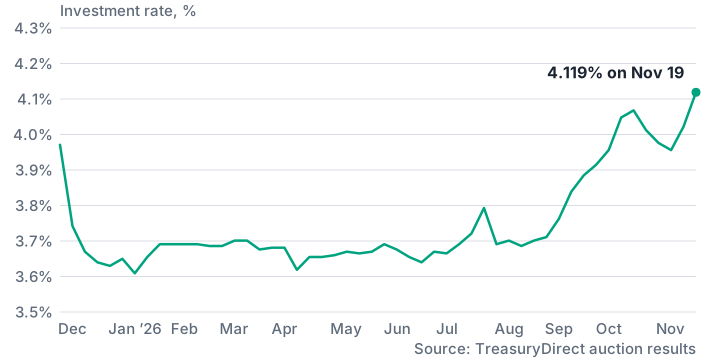
Nov. 13, 2025
3.966%
0.153 points below this week's rate.
First auction of Dec. 2025
3.74%
Down from close to 4%.
Dec. 2025 to Aug. 2026
3.61% to 3.79%
Nine flat months, usually near 3.68%. The low was 3.61% on Jan. 8.
Aug. 27 to Oct. 15, 2026
3.71% → 4.068%
Rose at almost every auction for seven weeks. Over the same stretch the Fed raised its target range from 3.50%–3.75% to 3.75%–4.00%, and the effective fed funds rate moved from 3.63% to 3.88% on Sept. 17.
Oct. 22 to Nov. 19, 2026
4.012% → 4.119%
Three small slips to 3.956% on Nov. 5, then up to 4.022% on Nov. 12 and 4.119% on Nov. 19, above the Oct. 15 peak. On Oct. 28 the Fed held its range; two officials voted for another increase.
Why it moves: a 4-week bill is close to cash, so its rate tracks what markets expect the Fed’s rate to be over the next month. It started rising before the Fed acted and on Nov. 19 moved above its October peak.
What $10,000 earns
T-bills sell at a discount and pay full face value at maturity; the difference is your interest. The Nov. 19 auction applied to $10,000 of face value:
| Amount | |
|---|---|
| You pay on Nov. 24 | $9,968.50 |
| You get back on Dec. 22 | $10,000.00 |
| Interest over 28 days | $31.50 |
| After 22% federal tax | $24.57 |
| State and local tax | $0 (exempt) |
The same $9,968.50 in a savings account for 28 days:
| Savings APY | Interest before tax | After 22% federal + 5% state tax |
|---|---|---|
| 0.38% (FDIC national average, Oct. 2026) | $2.90 | $2.12 |
| 4.00% | $30.04 | $21.93 |
| 4.49% (break-even) | $33.66 | $24.57 |
So a bank account needs about 4.49% APY to match this week’s bill with a 22% federal bracket and 5% state tax, or about 4.20% in a state with no income tax. Try your own brackets in the T-bill calculator. This ignores compounding beyond 28 days: if you keep rolling 4-week bills, each new one is bought at that week’s rate. A weekly 4-week ladder spreads that out so some money comes back every week.
How the 4-week bill compares
| Option | What you earn | Rate locked? | Getting your money | State tax |
|---|---|---|---|---|
| 4-week T-bill | 4.119% investment rate (Nov. 19) | Yes, for 28 days | At maturity, or sell early through a broker | Exempt |
| Savings account | 0.38% APY national average; online banks pay far more | No, the bank can change it any day | Any day | Taxed |
| Bank money market account | 0.63% APY national average | No | Any day, sometimes with limits | Taxed |
| Government money market fund | 7-day yield, usually close to short T-bill rates | No | Next business day | Partly exempt, depending on the fund’s holdings |
| 3-month CD | 1.14% APY national average | Yes, for 3 months | Early withdrawal penalty | Taxed |
Averages are from the FDIC’s October 2026 table across all U.S. banks; the best online savings accounts pay several times more, and money market funds post their own 7-day yields daily. The trade-off in one line: a savings account lets you withdraw any day but the rate can drop whenever the bank decides, while a 4-week bill locks the rate for 28 days and skips state tax.
If your cash sits in a brokerage’s default fund, see how SPAXX at Fidelity and VMFXX at Vanguard compare with this week’s bill.
When the next auction is
Treasury auctions 4-week bills every week:
| Step | Date | Detail |
|---|---|---|
| Announcement | Tuesday, Nov. 24, 2026 (expected) | Offering size and CUSIP published |
| Auction | Wednesday, Nov. 25, 2026 (expected; moved up a day for Thanksgiving) | Non-competitive bids close 11:00 a.m. Eastern, competitive 11:30 a.m. |
| Issue | Tuesday, Dec. 1, 2026 (expected) | You pay and the bill starts earning |
Holidays shift the schedule, so check TreasuryDirect’s upcoming auctions before you bid. We update this page once the results are out.
How to buy a 4-week T-bill
Either way you place a non-competitive bid: you accept the auction’s rate and are guaranteed the bills. The bills are the same; the accounts differ.
| TreasuryDirect | Brokerage account | |
|---|---|---|
| Minimum | $100, in $100 steps | Usually $1,000, in $1,000 steps |
| Selling before maturity | Not possible for a 4-week bill (new bills must be held 45 days) | Sell any trading day |
| Rolling into the next bill | Schedule reinvestment when you buy | Automatic rollover at some brokers, such as Fidelity and Schwab |
| Where the cash lands | Your linked bank account | Your brokerage cash balance |
Our guide to how to buy T-bills walks through both, step by step, and a second guide covers the screens at Fidelity and Schwab.
Reading the auction numbers
- High discount rate 4.050%
- The rate the auction cleared at, as a markdown from face value on a 360-day year. Every winning bidder, including small non-competitive buyers, pays the same price.
- Investment rate 4.119%
- What you earn on the money you actually pay, on a 365-day year. Always a little higher than the discount rate, and the one to compare with an APY.
- Price per $100 $99.685000
- What you pay for each $100 of face value.
- Bid-to-cover ratio 2.55
- Dollars bid for each dollar Treasury sold. 2.55 was down from 2.94 the week before and well above 1, so the auction was easily covered.
- CUSIP 912797WG8
- The nine-character ID of this specific bill, used by brokers and TreasuryDirect.
Our T-bill calculator converts any discount rate into an investment rate and dollar amounts.
How we got these numbers: auction results come from TreasuryDirect’s published results for each 4-week bill. We calculated the dollar examples from the official price per $100 and the savings examples with the same APY formula banks use. The chart is drawn from the last 52 auctions. Rates change every week; check the source before you act. See how we test and our disclaimer.
Questions people ask
What is the 4-week T-bill rate right now?
At the Nov. 19, 2026 auction the 4-week bill sold at a 4.050% high discount rate, which works out to a 4.119% investment rate. The investment rate is the one to compare with a savings account APY. The next auction is expected Wednesday, Nov. 25, a day early because of Thanksgiving.
What is the difference between the discount rate and the investment rate?
The discount rate is the markdown from face value, quoted on a 360-day year. The investment rate is what you actually earn on the money you pay, on a 365-day year, so it is always a little higher. On Nov. 19 the two were 4.050% and 4.119%.
How much does a $1,000 4-week T-bill cost?
At the Nov. 19, 2026 price of $99.685000 per $100, a $1,000 bill costs $996.85 and pays $1,000 at maturity on Dec. 22, so you earn $3.15 over 28 days.
Is 4-week T-bill interest taxed?
It is subject to federal income tax but exempt from state and local income tax. That exemption is why a T-bill can beat a bank account with a slightly higher headline rate if you live in a state with income tax.
How often are 4-week T-bills auctioned?
Every week. Treasury usually announces the auction on Tuesday, holds it on Thursday, and issues the bills the following Tuesday. Holidays move the dates, so check the TreasuryDirect calendar.
Sources
Update log
- Updated with the Nov. 19, 2026 auction.
- Updated with the Nov. 12, 2026 auction.
- Updated with the Nov. 5, 2026 auction.
- Reorganized the page so the rate, price and CUSIP come first; moved explanations into tables and a glossary. No figures changed.
- Corrected the bid-to-cover comparison (highest since June 11, not mid-September) and added the Fed's Oct. 28 decision.
- Updated with the Oct. 29, 2026 auction; added CUSIPs to the auction table.
- First published with the Oct. 22, 2026 auction.