VMFXX 7-Day Yield: 3.89%, and When VUSXX Pays More
Vanguard's VMFXX paid a 3.89% 7-day yield on Nov. 6, 2026. Its 0.11% fee, 29 months of SEC data, state tax, and when VUSXX or a T-bill is the better pick.
VMFXX paid a 3.89% 7-day yield on Nov. 6, 2026, according to Vanguard’s fund page. That is up from 3.79% at the end of September and 3.88% at the end of October, after the Federal Reserve raised rates in mid-September. On $10,000 it works out to about $389 a year before tax, if the yield held steady.
VMFXX, the Vanguard Federal Money Market Fund, is where uninvested cash sits in a Vanguard brokerage account. It is one of the cheapest large money market funds, which is why it pays more than most of its rivals. The more useful question for many readers is a different one: whether Vanguard’s own Treasury fund, VUSXX, would leave them with more after state tax.
VMFXX at a glance
| VMFXX | |
|---|---|
| 7-day SEC yield, Nov. 6, 2026 | 3.89% |
| Compound yield, Nov. 6, 2026 | 3.96% |
| 7-day yield, Oct. 31, 2026 (SEC filing) | 3.88% |
| 7-day yield before fees, Oct. 31 | 3.99% |
| Expense ratio | 0.11% (0.10% management fee, 0.01% other) |
| Minimum | $0 as the settlement fund; $3,000 otherwise |
| Share price | $1.00 (aims to keep it there) |
| Fund type | Government money market fund |
| Fund size, Oct. 31 | $374 billion |
| Weighted average maturity, Oct. 31 | 25 days |
| Calendar-year return | 5.23% in 2024, 4.22% in 2025 |
The Nov. 6 yields, minimum and calendar-year returns come from Vanguard’s VMFXX page; fees from the fund’s summary prospectus; the Oct. 31 figures, size and maturity from its Form N-MFP3 filed with the SEC on Nov. 6. The fund page gives one day’s yield. The SEC filing lists the 7-day yield for every business day of the month, before and after fees, plus every holding, which is what the history below is built from. We update this page with each new monthly filing.
29 months of VMFXX yields
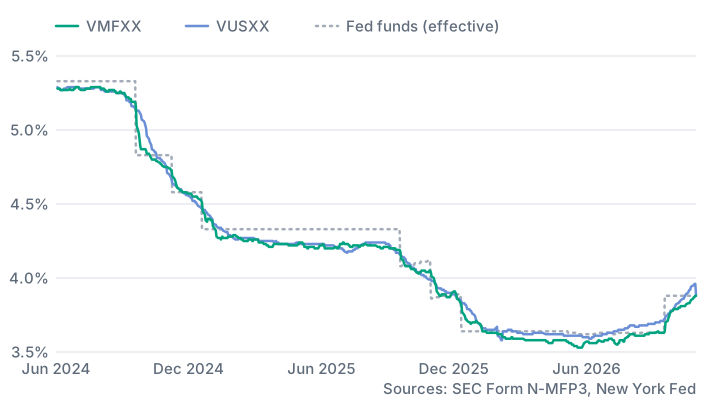
Every money market fund files Form N-MFP3 with the SEC each month, and the form has existed since June 2024. Here is VMFXX’s daily 7-day yield over that time, next to Vanguard Treasury Money Market Fund (VUSXX) and the federal funds rate:
| Month end | VMFXX 7-day yield | Before fees | VUSXX 7-day yield | SPAXX 7-day yield |
|---|---|---|---|---|
| Oct. 2026 | 3.88% | 3.99% | 3.89% | 3.55% |
| Sept. 2026 | 3.79% | 3.90% | 3.80% | 3.48% |
| Aug. 2026 | 3.63% | 3.74% | 3.69% | 3.33% |
| July 2026 | 3.62% | 3.73% | 3.68% | 3.32% |
| June 2026 | 3.58% | 3.69% | 3.63% | 3.29% |
| May 2026 | 3.56% | 3.67% | 3.60% | 3.26% |
| Apr. 2026 | 3.58% | 3.69% | 3.62% | 3.30% |
| Mar. 2026 | 3.58% | 3.69% | 3.63% | 3.29% |
| Feb. 2026 | 3.59% | 3.70% | 3.63% | 3.32% |
| Jan. 2026 | 3.62% | 3.73% | 3.61% | 3.33% |
| Dec. 2025 | 3.71% | 3.82% | 3.72% | 3.43% |
| Nov. 2025 | 3.90% | 4.01% | 3.89% | 3.60% |
| Oct. 2025 | 4.01% | 4.12% | 3.98% | 3.77% |
| Sept. 2025 | 4.08% | 4.19% | 4.10% | 3.80% |
Three patterns hold across all 29 month ends from June 2024 to October 2026:
- The fee is steady. VMFXX’s yield was 0.10 to 0.11 points below its yield before fees every month, matching its 0.11% expense ratio.
- VUSXX is nearly tied at month ends. The Treasury fund’s yield was within 0.06 points of VMFXX’s at 28 of the 29 month ends, higher at 18 of them. Within months it can pull further ahead: from Oct. 15 to Oct. 29, 2026 it led by 0.07 to 0.09 points before dropping back to 3.89% on Oct. 30, and on Vanguard’s page it was 0.07 ahead on Nov. 6. The biggest gap was September 2024: after the Fed’s half-point cut on Sept. 18, VMFXX’s yield fell faster. VUSXX, holding longer-dated bills, was ahead by as much as 0.23 points on Sept. 26 and stayed more than 0.06 points ahead until mid-October.
- SPAXX trails by about 0.3 points. Fidelity’s government fund paid 0.24 to 0.33 points less than VMFXX at every month end, almost exactly the difference in fees. Our SPAXX yield page breaks that gap down.
Why VMFXX moves with the Fed, a little late
VMFXX’s yield follows the federal funds rate, with a short delay. When the Fed raised its target range to 3.75%–4.00% in September 2026, the effective rate rose from 3.63% to 3.88% on Sept. 17. VMFXX was at 3.64% that day, 3.74% on Sept. 23, 3.79% on Sept. 30, 3.88% on Oct. 30 and 3.89% on Nov. 6. The same delay works on the way down: after the December 2025 cut took the effective rate from 3.89% to 3.64% on Dec. 11, VMFXX went from 3.83% on Dec. 10 to 3.72% a week later and 3.64% by mid-January.
The delay has two causes. The 7-day yield looks back a week, and the fund holds bills and notes bought before the change, which pay the old rate until they mature or reset. VMFXX’s weighted average maturity was 25 days on Oct. 31, shorter than SPAXX’s 39 days, so it catches up faster after a rate change, in either direction.
What VMFXX owns
On Oct. 31, 2026, by market value of its holdings:
| Holding | Share |
|---|---|
| U.S. Treasury securities (mostly bills) | 38.7% |
| Federal Home Loan Bank debt | 34.7% |
| Repurchase agreements backed only by Treasuries and cash | 26.1% |
| Fannie Mae debt | 0.3% |
| Federal Farm Credit Banks debt | 0.2% |
The prospectus requires the fund to keep at least 99.5% of its assets in cash, U.S. government securities and repurchase agreements backed by them, and says it generally invests 100% that way. The prospectus also notes that some holdings are not backed by the full faith and credit of the U.S. government. Federal Home Loan Bank debt, about a third of the fund, is one of them; the Treasury bills are backed. On Sept. 30, 55% of the fund’s assets could be turned into cash within a day and 68% within a week, well above the SEC’s minimums of 25% and 50%. Its market-based value per share, reported daily, stayed between $0.9999 and $1.0000 in September.
None of this makes VMFXX a bank account. The prospectus says you could lose money, that the fund is not FDIC insured and that Vanguard is not required to reimburse losses. Large government money market funds have kept their $1.00 price through past crises, including 2008 and March 2020.
VMFXX vs. VUSXX: the state tax question
VMFXX’s dividends are ordinary income for federal tax. For state income tax, most states let you leave out the part that came from U.S. government obligations. Treasury debt and Federal Home Loan Bank debt count; income from repurchase agreements doesn’t, even when the collateral is Treasuries.
Each January, Vanguard publishes the exempt share for each fund for the year before:
| Share of dividends from U.S. government obligations | 2024 | 2025 |
|---|---|---|
| VMFXX (Federal) | 59.87% | 66.61% |
| VMRXX (Cash Reserves Federal) | 63.61% | 69.58% |
| VUSXX (Treasury) | 100% | 100% |
Vanguard says both VMFXX and VUSXX met the extra test that California, Connecticut and New York apply: at least half of the fund’s assets in U.S. government obligations at the end of each quarter. For how T-bills themselves are taxed by states, see how T-bills are taxed.
VUSXX usually pays about the same as VMFXX before tax, and on Nov. 6 it paid 0.07 points more, so the exempt share only widens its lead. Here is what each yield is worth after state tax at Nov. 6 yields, using the 2025 exempt shares:
| State income tax rate | VMFXX after state tax | VUSXX after state tax | Difference on $50,000 |
|---|---|---|---|
| 0% (or an IRA) | 3.89% | 3.96% | VUSXX +$35 |
| 5% | 3.83% | 3.96% | VUSXX +$67 |
| 9.3% | 3.77% | 3.96% | VUSXX +$95 |
The math: VMFXX’s taxable share is 33.39% of its yield, so a 5% state tax takes 3.89% × 0.3339 × 0.05, about 0.06 points. On Nov. 6 VUSXX was ahead even before tax. When the two yields are equal, as they were on Nov. 5, VUSXX still comes out ahead at any state income tax rate; if VMFXX were 0.01 point ahead, VUSXX would win at any state rate above roughly 0.8%. The table leaves out the federal deduction for state taxes, which shrinks the difference a little for people who itemize, and the exempt share changes every year.
The difference is real but small: tens of dollars a year on $50,000. If your cash sits in an IRA or you live in a state with no income tax, it comes down to the before-tax gap, which moves from week to week.
VMFXX vs. VMRXX
Vanguard Cash Reserves Federal Money Market Fund (VMRXX) is VMFXX’s near-twin. On Oct. 31 it held almost exactly the same mix (37.0% Treasury, 36.2% Federal Home Loan Bank debt, 26.3% Treasury repurchase agreements), charges 0.10% instead of 0.11% and paid 3.89% against VMFXX’s 3.88%. On Nov. 6 it showed 3.90% to VMFXX’s 3.89%. A 0.01-point gap is $5 a year on $50,000, so most people need not bother switching between them.
Should you keep your cash in VMFXX?
In a Vanguard brokerage account, cash from deposits, sales and dividends lands in the settlement fund, which is VMFXX unless you choose Vanguard Cash Deposit instead. Whether to leave it there depends on what the cash is for:
- Cash you’re about to spend or invest: leave it in VMFXX. It pays every day, has no minimum as the settlement fund, and trades in the account settle from it automatically.
- A balance that stays put in a taxable account, in a state with income tax: consider moving it to VUSXX. It has paid about the same or a little more, almost all of its income escapes state tax, and you can buy it in the same account once you have $3,000. You’ll have to sell it yourself when you need the cash, because it is not the settlement fund.
- Money you won’t need for a month or more: compare with T-bills. A 4-week T-bill sold at a 4.119% investment rate on Nov. 19, 2026, and its interest is free of state tax in every state. For longer, compare T-bill rates by term or build a T-bill ladder. Vanguard Brokerage sells new-issue bills at auction; see how to buy T-bills.
- You’d rather have FDIC insurance: look at Vanguard Cash Deposit, Vanguard’s bank sweep alternative to VMFXX, or at high-yield savings accounts. Check the APY against VMFXX’s current yield before switching; bank rates can change at any time.
- You’re at Fidelity and wondering whether to move: VMFXX paid about 0.3 points more than SPAXX (0.33 at the end of October), roughly $150 a year on $50,000. Fidelity offers cheaper share classes and Treasury funds of its own; our SPAXX page and money market fund comparison show the options.
VMFXX’s longer record
VMFXX has existed since 1981. Its yearly returns over the past decade show how completely a money market fund depends on the Fed: next to nothing when rates were near zero, about 5% when they peaked.
| Year | VMFXX | VUSXX |
|---|---|---|
| 2025 | 4.22% | 4.23% |
| 2024 | 5.23% | 5.24% |
| 2023 | 5.09% | 5.05% |
| 2022 | 1.55% | 1.50% |
| 2021 | 0.01% | 0.01% |
| 2020 | 0.45% | 0.47% |
| 2019 | 2.14% | 2.14% |
| 2018 | 1.78% | 1.80% |
| 2017 | 0.81% | 0.79% |
| 2016 | 0.30% | 0.25% |
| 2015 | 0.04% | 0.02% |
Calendar-year total returns from Vanguard’s fund pages. For 2026 through Nov. 4, VMFXX had returned 3.10%.
How we got these numbers: VMFXX’s Nov. 6 yields, minimum and yearly returns come from Vanguard’s fund pages, recorded on Nov. 9, 2026; the 2026 return through Nov. 4 was recorded on Nov. 6. Its daily yields, holdings, assets, maturity, liquidity and share values come from the monthly Form N-MFP3 filings of VMFXX, VUSXX and VMRXX with the SEC, June 2024 through Oct. 31, 2026, read with a script that collects each fund’s 7-day net yield and 7-day gross yield for every business day; SPAXX figures come from Fidelity’s filings the same way. Fees come from the summary prospectus, state tax shares from Vanguard’s U.S. government obligations reports for 2024 and 2025, and the fed funds rate from the Federal Reserve Bank of New York. We update this page each month when the new filing arrives. We are not paid by Vanguard or Fidelity. See how we test and our disclaimer.
Questions people ask
What is the VMFXX 7-day yield today?
3.89% on Nov. 6, 2026, the latest figure on Vanguard's VMFXX page when we checked. It was 3.79% at the end of September and 3.88% at the end of October, and has risen since the Federal Reserve raised rates in mid-September. The yield changes every business day, so check Vanguard's fund page for the current number.
What's the difference between the 7-day yield and the compound yield?
The 7-day SEC yield is the fund's income over the past seven days, after expenses, stated as a yearly rate. The compound yield assumes you reinvest the daily dividends for a year, so it is a little higher: 3.96% next to the 3.89% 7-day yield on Nov. 6, 2026. Neither is a promise; both move with short-term interest rates.
Is VMFXX FDIC insured?
No. VMFXX is a mutual fund, not a bank deposit. Its prospectus says you could lose money, that it is not FDIC insured and that Vanguard is not required to cover losses. If you want FDIC coverage for brokerage cash, Vanguard offers Vanguard Cash Deposit as an alternative settlement option.
Is VMFXX better than SPAXX?
On yield, yes, because it costs less. At the end of October 2026, VMFXX earned 3.99% before fees and SPAXX 3.97%. VMFXX's expense ratio is 0.11% and SPAXX's 0.42%, so VMFXX paid 3.88% and SPAXX 3.55%. VMFXX returned 5.23% in 2024 and 4.22% in 2025; SPAXX returned 4.92% and 3.95%.
Should I use VUSXX instead of VMFXX?
In a taxable account in a state with income tax, often yes. The two have paid within a few hundredths of a point of each other at most month ends, though VUSXX was up to 0.09 points ahead in late October and 0.07 ahead on Nov. 6, 2026. All of VUSXX's 2025 income came from U.S. government obligations, which most states don't tax, against 66.61% for VMFXX. In an IRA or a state with no income tax, the difference is close to nothing, and VMFXX is simpler because it is the settlement fund.
Is VMFXX income taxed by my state?
Partly. Vanguard reported that 66.61% of VMFXX's 2025 ordinary dividends came from U.S. government obligations, which most states exempt, and that the fund met the 50% test California, Connecticut and New York require. The rest, mostly from repurchase agreements, is taxed by your state. Federal tax applies to all of it.
Does VMFXX have a minimum?
Not as your Vanguard brokerage settlement fund: Vanguard says the initial investment is $0 when VMFXX is used that way. Opened as a separate fund position, the minimum is $3,000, and additional purchases can be as small as $1.
Sources
- Vanguard Federal Money Market Fund (VMFXX) fund page, yield as of Nov. 6, 2026
- Vanguard Treasury Money Market Fund (VUSXX) fund page, yield as of Nov. 6, 2026
- SEC Form N-MFP3, Vanguard Federal Money Market Fund, Oct. 31, 2026
- SEC Form N-MFP3, Vanguard Federal Money Market Fund, Sept. 30, 2026
- SEC Form N-MFP3, Vanguard Treasury Money Market Fund, Oct. 31, 2026
- SEC Form N-MFP3, Vanguard Cash Reserves Federal Money Market Fund, Oct. 31, 2026
- SEC EDGAR: all N-MFP3 filings by Vanguard Money Market Reserves (VMFXX's trust)
- Vanguard Federal Money Market Fund summary prospectus, Dec. 19, 2025 (as supplemented June 30, 2026), filed with the SEC
- Vanguard: U.S. government obligations income information for 2025
- Vanguard: U.S. government obligations income information for 2024
- Vanguard: Money market funds (settlement fund minimum)
- Vanguard Cash Deposit (alternative settlement option)
- SEC Form N-MFP3, Fidelity Government Money Market Fund (SPAXX), Oct. 31, 2026
- Federal Reserve Bank of New York: effective federal funds rate
- TreasuryDirect: auction results for 4-week bills
Update log
- Updated the 4-week T-bill comparison to the Nov. 19, 2026 auction.
- Updated the 4-week T-bill comparison to the Nov. 12, 2026 auction.
- Updated to the SEC filings for October 2026 and Vanguard's Nov. 6 yields. VUSXX now pays 0.07 points more than VMFXX, so the after-state-tax table favors it at every tax rate.
- First published with Vanguard's Nov. 4, 2026 yields and SEC filings through Sept. 30, 2026.