Emergency Fund: How Much to Keep and Where It Earns 4%
Aim for 3 to 6 months of expenses. $20,000 earns $76 a year at the average bank and $854 in a top savings account. Savings, funds and T-bills compared.
Emergency fund, Nov. 2026
Rates: Bankrate, Nov. 10; FDIC, October 2026
- Usual target
- 3 to 6 months
- Of spending you can't skip
- Top savings account
- 4.27% APY
- Peak Bank, no promotion
- Average savings account
- 0.38% APY
- FDIC national rate
- $20,000 for a year
- $854 vs. $76
- Top account vs. the average
Keep three to six months of essential spending in a high-yield savings account and you have done most of what matters. In November 2026 the best savings accounts pay 4.2% to 4.3% APY, and the average one pays 0.38%. On a $20,000 fund that is $854 a year against $76.
Money market funds and Treasury bills are sound places for emergency cash too, and after state tax they sometimes pay more. But the gaps among the good options are small, about $144 a year on $20,000 before tax. The gap between any of them and an average bank account is $630 or more.
How much to keep
The common rule is three to six months of expenses. Two sets of numbers show where it comes from.
How long a job loss lasts. Among people unemployed in October 2026, half had been out of work for 11.9 weeks or more, according to the Bureau of Labor Statistics. That is just under three months. The average was 27.1 weeks, and 27.6% had been looking for 27 weeks or longer, which is past six months. So three months of savings would have covered the time out of work so far for about half of them, and six months for about 72%.
What goes wrong without a job loss. In the Federal Reserve’s survey of households for 2025, 59% of adults had at least one major unexpected expense in the past year. The most common were a major vehicle repair or replacement (30% of adults), a major house or appliance repair (22%) and a major medical bill (21%).
Most people are short of the target. In the same survey, 55% of adults said they had set aside enough to cover three months of expenses, and 63% said they would pay a $400 emergency with cash or its equivalent. Among adults with family income from $25,000 to $49,999, only 39% had three months saved.
Lean toward three months if your household has two steady incomes, low fixed costs and good insurance. Lean toward six or more if you rely on one income, your pay is irregular, you are self-employed, or your work is specialized enough that a new job could take a long time to find.
If either figure looks far away, start smaller. The Consumer Financial Protection Bureau’s advice is to look at the unexpected bills you have had before and set a first goal that would cover them. Even one month of expenses covers many car and home repairs.
Three and six months in dollars
Count the spending you could not stop if your income did: rent or mortgage, utilities, food, insurance, transport, minimum debt payments, childcare. If you don’t track it, the Bureau of Labor Statistics’ spending survey gives a ceiling. These are average totals for 2025, grouped by household income:
| Households by income | Average spending a month | 3 months | 6 months |
|---|---|---|---|
| Lowest fifth (average income $18,125) | $3,200 | $9,500 | $19,000 |
| Second fifth ($46,080) | $4,300 | $12,900 | $25,700 |
| Middle fifth ($78,584) | $5,700 | $17,200 | $34,500 |
| Fourth fifth ($126,349) | $7,700 | $23,100 | $46,100 |
| Highest fifth ($286,188) | $13,300 | $39,900 | $79,800 |
| All households | $6,800 | $20,500 | $41,000 |
Figures are rounded to the nearest $100 from the annual averages, such as $68,983 for the middle fifth and $81,905 for all households. They include spending you could pause in an emergency, such as travel, entertainment and retirement contributions, so your own number is probably lower. The examples below use $20,000, about three months for the average household.
What $20,000 earns in each place
Here is a year of interest on $20,000 at each rate, if the rate stayed where it is. The last column takes off 22% federal tax and a 5% state tax, counting the share of each fund’s income that states exempt.
| Where | Rate | A year on $20,000 | After 22% federal and 5% state tax |
|---|---|---|---|
| Interest checking, national average | 0.07% APY | $14 | $10 |
| Savings account, national average | 0.38% APY | $76 | $55 |
| Top savings account (Peak Bank) | 4.27% APY | $854 | $623 |
| No-penalty CD, 11 months (Colorado Federal Savings Bank) | 3.95% APY | $790 | $577 |
| Fidelity Government Money Market Fund (SPAXX) | 3.55% 7-day yield | $710 | $536 |
| Vanguard Federal Money Market Fund (VMFXX) | 3.88% 7-day yield | $776 | $592 |
| Vanguard Treasury Money Market Fund (VUSXX) | 3.97% 7-day yield | $794 | $619 |
| iShares 0-3 Month Treasury Bond ETF (SGOV) | 3.85% 30-day yield | $770 | $599 |
| 4-week Treasury bill, rolled over | 4.119% investment rate | $824 | $643 |
| 13-week Treasury bill, rolled over | 4.257% investment rate | $851 | $664 |
National averages are from the FDIC’s October 2026 table. Peak Bank’s rate is from Bankrate’s table, dated Nov. 10, 2026; EverBank paid 4.20% on Nov. 12. The no-penalty CD is the highest in Bankrate’s list of picks, and the bank’s own rate page showed the same 3.95% on Nov. 12 (a rate it has offered since May 6). The Vanguard and iShares yields are from their fund pages for Nov. 10, and SPAXX’s is from its SEC filing for Oct. 30. The bills sold at auction on Nov. 19 (4-week) and Nov. 16 (13-week). Some banks advertise higher rates for the first few months; those are left out because they end. California, Connecticut and New York exempt a fund’s government income only if at least half of its assets were federal debt at the end of each quarter. SPAXX missed that test for 2025, so in those states all of its income was taxable; the other funds here passed.
Three things stand out:
- The big step is leaving the average account. Going from 0.38% to any option above 3.5% adds about $630 to $780 a year on $20,000.
- Before tax, the top savings account leads. It beats every fund, and only the 13-week bill comes close.
- After state tax, the order tightens. Bank interest is taxed by your state and T-bill interest is not, so in a 5% state the 13-week bill ends $41 ahead of the savings account and the 4-week bill $20 ahead, while VUSXX ends $4 behind it.
Rates move. Fund and bill yields follow the Federal Reserve’s rate within weeks; banks change theirs when they choose. See money market fund rates and T-bill rates today for current figures, and high-yield savings vs. money market for how the bank and fund versions differ.
How fast you can get the money
An emergency fund has to arrive in time, and it has to be worth what you put in. This is how the options compare on that:
| Where | How you get cash | How long | Can the balance fall? |
|---|---|---|---|
| High-yield savings account | Transfer to checking | 1 to 3 business days | No. FDIC insured to $250,000 per depositor, per bank |
| Money market fund | Sell shares any business day | Usually the same or next business day at your brokerage | It aims for $1.00 a share; not insured |
| Treasury bill ETF such as SGOV | Sell like a stock | Sale settles the next business day | By a few cents a share, briefly |
| T-bill at a brokerage | Wait for maturity, or sell | Sale settles the next business day | A sale is at the market price, which dips if rates have risen |
| T-bill at TreasuryDirect | Wait for maturity | Up to the bill’s full term | No, but you can’t sell there; a transfer to a broker needs a 45-day hold |
| No-penalty CD | Close the CD | Allowed from about a week after funding, usually the whole balance at once | No. FDIC insured |
| Regular CD | Break the CD | Days | You pay a penalty, often 3 months of interest on a 1-year CD |
| I bond | Cash it at TreasuryDirect | Not possible in the first 12 months | You lose 3 months of interest before 5 years |
Money market funds and ETFs held at a brokerage are covered by SIPC if the brokerage fails and your assets are missing. SIPC does not cover a fall in value. Government money market funds hold short-term government debt, and the large ones kept their $1.00 price through 2008 and March 2020. That is not a guarantee: a small government fund that had bought risky structured notes paid 96 cents a share in 1994.
Add the time to move money from the account to where the bill gets paid. A sale at a brokerage still needs a transfer to your bank. For that reason, keep the first layer of the fund one step from your checking account.
Which one fits you
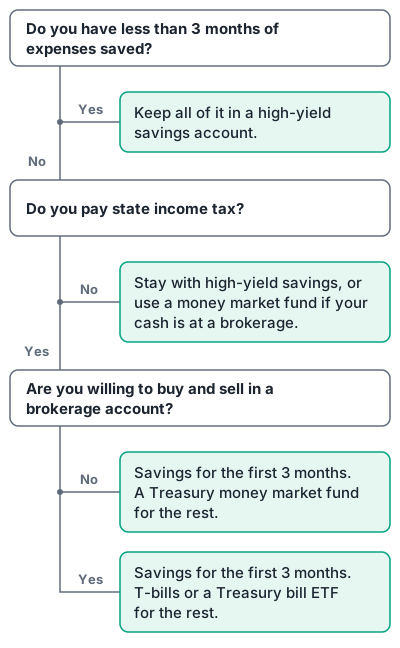
- You have less than three months saved. Put all of it in a high-yield savings account. At this size the yield differences are a few dollars a year, and speed and simplicity matter more.
- You have more, and no state income tax. The savings account still pays the most or close to it. A government money market fund makes sense only if your cash already sits at a brokerage; see SPAXX at Fidelity and VMFXX at Vanguard.
- You pay state income tax and don’t want to trade. Keep the first three months in savings and consider a Treasury money market fund for the rest. Nearly all of a Treasury fund’s income is exempt from state tax, and you buy and sell it at $1.00.
- You pay state income tax and are comfortable in a brokerage account. Keep the first three months in savings. For the rest, compare a T-bill ladder or a Treasury bill ETF; SGOV vs. SPAXX explains how the ETF works.
Is splitting the fund worth it?
Sometimes, and for less than most articles suggest. Take a $20,000 fund with $10,000 kept in the 4.27% savings account and the other $10,000 moved into 13-week T-bills at 4.257%, with a 22% federal bracket:
| State tax rate | Extra a year, after tax, from the $10,000 in bills |
|---|---|
| None | Minus $1 (the savings account pays slightly more) |
| 5% | About $20 |
| 9.3% (a common California bracket) | About $39 |
The math for the 5% row: the savings account keeps 4.27% × (1 − 0.22 − 0.05), or 3.12%. The bill keeps 4.257% × (1 − 0.22), or 3.32%. The difference, 0.20 points, is about $20 on $10,000.
With a 22% federal bracket, the 13-week bill beats this savings account once your state rate is above about 0.2%, so in practice in any state with an income tax. The 4-week bill needs a state rate above about 2.8%, and a Treasury money market fund at 3.97% above about 5.5%. Run your own rates through the T-bill calculator, and see how T-bills are taxed for the state rules.
So a second layer is worth setting up when the fund is large, your state tax is high, or you already buy bills. Otherwise one savings account does the job. If you do add layers, a common order is:
- First one to three months: high-yield savings, linked to your checking account.
- The rest: whichever pays most after your state tax among savings, a Treasury money market fund, a Treasury bill ETF and T-bills. How to buy T-bills covers both TreasuryDirect and brokerages; for an emergency fund, a brokerage is the better place because you can sell.
- A deep reserve, optional: I bonds more than a year old. Ones bought through April 2027 start at 5.51% and keep up with inflation, but they are locked for 12 months and limited to $10,000 a year per person, so they can only be added slowly, on top of a fund that is already complete.
Where not to keep it
- A checking account or a branch-bank savings account. At the national averages of 0.07% and 0.38%, $20,000 earns $14 to $76 a year.
- Stocks or stock funds. Prices can fall sharply, and they often fall when layoffs rise, which is when the fund is needed.
- A regular CD, for the first few months of the fund. The early withdrawal penalty is the cost of an emergency you were saving to avoid. For money you are sure you won’t need before a set date, see T-bills vs. CDs.
- I bonds less than a year old. They can’t be cashed at all.
- More than $250,000 at one bank. That is the FDIC limit per depositor, per bank, for each ownership category. Above it, use a second bank or T-bills, which the U.S. government backs without a limit.
Building it
The Consumer Financial Protection Bureau’s guide suggests making saving automatic: a recurring transfer on payday, or a split of your direct deposit so part of each paycheck goes straight to savings. A tax refund or other one-time money is the quickest way to get the first month in place.
Open the savings account before you have much to put in it. A separate account makes the money less likely to be spent. When you use the fund, refill it before you go back to other goals.
How we got these numbers: unemployment duration is from Table A-12 of the Bureau of Labor Statistics’ Employment Situation report for October 2026, seasonally adjusted. Household survey figures are from the Federal Reserve’s Economic Well-Being of U.S. Households in 2025, published in May 2026. Spending by income group is from the Bureau of Labor Statistics’ Consumer Expenditures 2025 release of Oct. 29, 2026; we divided the annual averages by 12, 4 and 2 and rounded to the nearest $100. Bank rates are from the FDIC’s October 2026 national rates table and Bankrate’s rate tables, fund yields from Vanguard’s and iShares’ fund pages and SPAXX’s Form N-MFP3 filing with the SEC, and T-bill rates from TreasuryDirect’s auction results, all checked on Nov. 12, 2026. A year of interest is the rate times $20,000, with no compounding. After-tax figures use a 22% federal rate and a 5% state rate applied to the share of income that states can tax: all of it for bank accounts and CDs, none for T-bills and VUSXX, 4.86% for SGOV, 33.39% for VMFXX and 49.10% for SPAXX, from each company’s report for 2025. We are not paid by any bank or fund mentioned. See how we test and our disclaimer.
Questions people ask
How much should I have in an emergency fund?
The usual target is three to six months of the spending you can't skip: housing, food, insurance, transport, debt payments. Three months fits a household with two steady incomes; six or more fits a single income, irregular pay or a job that would take a long time to replace. Among people unemployed in October 2026, half had been out of work 11.9 weeks or more and 27.6% for at least 27 weeks. If that is out of reach now, even one month covers many car and home repairs.
Where is the best place to keep an emergency fund?
For most people, a high-yield savings account at an FDIC-insured online bank. In November 2026 the best ones paid 4.2% to 4.3% APY without a promotion, against a national average of 0.38%. The balance can't fall, and a transfer reaches your checking account in one to three business days. If your cash is already at a brokerage, a government money market fund is a close second.
Should I keep my emergency fund in a money market fund?
It works well if you already use a brokerage. Government money market funds aim to keep a $1.00 share price and you can sell on any business day. In early November 2026 they yielded 3.55% to 3.97% depending mostly on their fees, a little less than the best savings accounts. They are not FDIC insured, but they hold government debt, and part or all of their income may be free of state tax.
Can I use T-bills for an emergency fund?
Yes, for the part you are least likely to need. A bill held at a brokerage can be sold on any trading day, and the cash settles the next business day. A bill bought at TreasuryDirect can't be sold there, so you wait for it to mature. A ladder of 4-week bills returns part of the money every week. T-bill interest is free of state and local income tax, which is the main reason to bother.
Are I bonds good for an emergency fund?
Not for the first layer. You can't cash an I bond in its first 12 months, and before five years you give up the last three months of interest. Once a bond is more than a year old it can serve as a deep reserve behind your savings account. I bonds bought through April 2027 pay 5.51% for their first six months, and each person can buy up to $10,000 a year.
Should I keep my emergency fund in a CD?
A regular CD is a poor fit for money you may need without notice, because breaking it costs a penalty, often three months of interest on a 1-year CD. A no-penalty CD lets you take the money out after the first week, usually all at once. The best in Bankrate's list, Colorado Federal Savings Bank's 11-month CD, paid 3.95% APY in November 2026, less than the best savings accounts.
Sources
- Federal Reserve: Economic Well-Being of U.S. Households in 2025, savings and investments (May 2026)
- Federal Reserve: Economic Well-Being of U.S. Households in 2025, executive summary
- Bureau of Labor Statistics: Consumer Expenditures 2025, released Oct. 29, 2026
- Bureau of Labor Statistics: Employment Situation, Table A-12, unemployed persons by duration, October 2026
- Consumer Financial Protection Bureau: An essential guide to building an emergency fund
- FDIC: National rates and rate caps, October 2026
- FDIC: Deposit insurance, understanding coverage
- Bankrate: Best high-yield savings rates, checked Nov. 12, 2026
- Bankrate: Best no-penalty CD rates, checked Nov. 12, 2026
- Colorado Federal Savings Bank: deposit rates, no-penalty CD, checked Nov. 12, 2026
- Vanguard Federal Money Market Fund (VMFXX), yield as of Nov. 10, 2026
- Vanguard Treasury Money Market Fund (VUSXX), yield as of Nov. 10, 2026
- SEC Form N-MFP3, Fidelity Government Money Market Fund (SPAXX), Oct. 31, 2026
- iShares 0-3 Month Treasury Bond ETF (SGOV), 30-day SEC yield as of Nov. 10, 2026
- TreasuryDirect: auction results for 4- and 13-week bills
- TreasuryDirect: I bonds
- Fidelity: 2025 percentage of income from U.S. government securities
- Vanguard: U.S. government obligations income information for 2025
- iShares: 2025 U.S. government source income information
- SIPC: What SIPC protects
Update log
- Updated the 4-week T-bill rate to the Nov. 19, 2026 auction.
- Updated the 13-week T-bill rate to the Nov. 16, 2026 auction.
- Updated the 4-week T-bill rate to the Nov. 12, 2026 auction.