3-Month T-Bill Rate: 4.26% at the Nov. 16 Auction
The 3-month T-bill sold at a 4.257% rate on Nov. 16, 2026 (CUSIP 912797TV9, matures Feb. 18, 2027). $10,000 earns $105.03; a bank needs 4.63% APY to match.
3-month T-bill, Nov. 16 auction, CUSIP 912797TV9
Next auction: Monday, Nov. 23
- Investment rate
- 4.257%
- Up 0.098 from Nov. 9
- Discount rate
- 4.155%
- $98.949708 per $100
- $10,000 bill
- $9,894.97
- Pays $105.03 on Feb. 18, 2027
- Bank APY to match
- 4.63%
- After 22% federal + 5% state tax
The 3-month Treasury bill sold at a 4.257% investment rate (4.155% discount rate) on Monday, Nov. 16, 2026. That is 0.098 points above the week before, the highest of the past year and the highest since Aug. 4, 2025, when it paid 4.268%. It is also about 0.37 points more than the same bill paid a year ago. Buy one now and you lock that rate until Feb. 18, 2027.
The 13-week bill is the classic “3-month T-bill rate” that banks, funds and the news quote as the risk-free cash rate. We update this page after every 13-week auction from Treasury’s own results. Other terms: T-bill rates today (4 to 52 weeks), the 4-week T-bill rate, the 6-month T-bill rate and the 52-week T-bill rate.
Nov. 16 auction results
| 3-month (13-week) bill | |
|---|---|
| CUSIP | 912797TV9 |
| Auction date | Monday, Nov. 16, 2026 |
| High discount rate | 4.155% |
| Investment rate | 4.257% |
| Price per $100 | $98.949708 |
| Issue date | Thursday, Nov. 19, 2026 |
| Maturity date | Thursday, Feb. 18, 2027 (91 days) |
| Offering size | $95 billion |
| Bid-to-cover ratio | 2.76 (normal for recent months) |
Compare the investment rate with a savings account’s or CD’s APY; the discount rate runs about 0.1 points lower on a 3-month bill. What each line means is in the glossary below.
The last 12 auctions
| Auction | Discount rate | Investment rate | Price per $100 | Bid-to-cover | Offered | CUSIP |
|---|---|---|---|---|---|---|
| Nov 16, 2026 | 4.155% | 4.257% | $98.949708 | 2.76 | $95B | 912797TV9 |
| Nov 9, 2026 | 4.060% | 4.159% | $98.973722 | 2.67 | $95B | 912797WB9 |
| Nov 2, 2026 | 4.040% | 4.138% | $98.978778 | 2.88 | $95B | 912797VV6 |
| Oct 26, 2026 | 4.050% | 4.149% | $98.976250 | 3.07 | $95B | 912797VU8 |
| Oct 19, 2026 | 4.095% | 4.195% | $98.964875 | 2.77 | $95B | 912797TM9 |
| Oct 13, 2026 | 4.085% | 4.185% | $98.967403 | 2.68 | $95B | 912797VT1 |
| Oct 5, 2026 | 4.050% | 4.149% | $98.976250 | 2.51 | $95B | 912797VS3 |
| Sep 28, 2026 | 4.110% | 4.211% | $98.961083 | 2.99 | $95B | 912797VJ3 |
| Sep 21, 2026 | 4.015% | 4.113% | $98.985097 | 2.77 | $92B | 912797TC1 |
| Sep 14, 2026 | 3.970% | 4.066% | $98.996472 | 2.64 | $92B | 912797VH7 |
| Sep 8, 2026 | 3.800% | 3.890% | $99.039444 | 2.61 | $92B | 912797VG9 |
| Aug 31, 2026 | 3.770% | 3.859% | $99.047028 | 2.77 | $92B | 912797VA2 |
Holding a bill and want its details? Look it up in our T-bill CUSIP lookup, which lists every bill sold in the past year.
One CUSIP, several auctions
If you search a 13-week bill’s CUSIP, you may find it listed as a 26-week or even a 52-week bill. That is not a mistake. Treasury does not create a new bill for each 13-week auction; it reopens the 26-week bill sold 13 weeks earlier, which matures on the same day. Every fourth week, that bill was itself first sold as a 52-week bill. Each auction has its own price, but they all share one CUSIP and one maturity date.
The bill sold on Nov. 16 has been auctioned three times:
| Auction | Sold as | Days to maturity | Investment rate | Price per $100 |
|---|---|---|---|---|
| Feb. 17, 2026 | 52-week bill | 364 | 3.480% | $96.617833 |
| Aug. 17, 2026 | 26-week bill | 182 | 3.907% | $98.089000 |
| Nov. 16, 2026 | 13-week bill | 91 | 4.257% | $98.949708 |
All three groups of buyers get $100 per $100 of face value on Feb. 18, 2027. What differs is the rate each one locked in. Someone who bought this bill in February earns 3.480% a year until it matures; someone who bought it this week earns 4.257%. The rate is fixed when you buy, so a later auction of the same CUSIP never changes what an earlier buyer earns.
Near the end of its life the bill usually gets one more sale: Treasury reopens it again as a 6-week bill. Every 13-week bill of the past year that has reached that point was sold this way. The Sept. 28 bill in the table above, 912797VJ3, was sold again as a 6-week bill on Nov. 17.
The past year
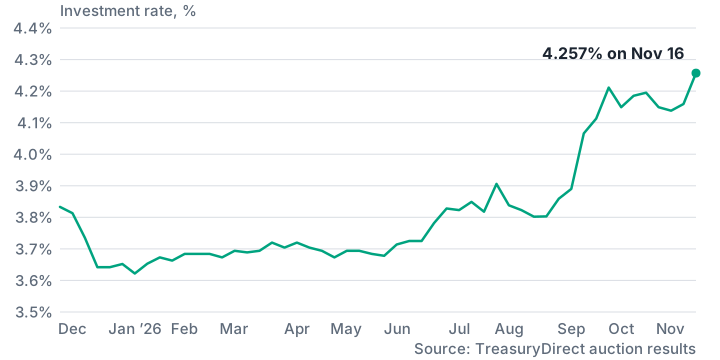
Nov. 17, 2025
3.885%
A year ago. Over the next month the rate fell to about 3.64%, around the Fed's Dec. 10, 2025 rate cut to a 3.50%–3.75% target range.
Jan. 5, 2026
3.622%
The low of the past twelve months. From then until mid-June it barely moved, staying between 3.65% and 3.73%.
Late June to August 2026
About 3.78% to 3.91%
A first, small step up, then a sideways summer.
Sept. 8 to Sept. 28, 2026
3.890% → 4.211%
The big move: about a third of a point in three weeks. Over the same stretch the Fed raised its target range to 3.75%–4.00%, and the effective fed funds rate moved from 3.63% to 3.88% on Sept. 17.
Oct. 5 to Nov. 9, 2026
4.138% to 4.195%
Settled just below the September high.
Nov. 16, 2026
4.257%
Up 0.098 in one week, to the highest rate of the past year.
Why the 3-month bill matters: it tracks the Fed’s policy rate closely, because three months only spans the next one or two Fed meetings. On Nov. 16 the effective fed funds rate was 3.88%, inside the Fed’s 3.75%–4.00% target range, and the 13-week bill paid 0.38 points more. When the 3-month rate drifts well above or below the fed funds rate, it often means markets expect the Fed’s next move to be up or down.
What $10,000 earns
T-bills sell at a discount and pay full face value at maturity; the difference is your interest. The Nov. 16 auction applied to $10,000 of face value:
| Amount | |
|---|---|
| You pay on Nov. 19, 2026 | $9,894.97 |
| You get back on Feb. 18, 2027 | $10,000.00 |
| Interest over 91 days | $105.03 |
| After 22% federal tax | $81.92 |
| State and local tax | $0 (exempt) |
The same $9,894.97 in a savings account or CD for 91 days:
| Account and APY | Interest before tax | After 22% federal + 5% state tax |
|---|---|---|
| Savings, 0.39% (FDIC national average, Nov. 2026) | $9.61 | $7.01 |
| 3-month CD, 1.14% (FDIC national average, Nov. 2026) | $28.00 | $20.44 |
| Savings or CD at 4.00% | $97.23 | $70.98 |
| Savings or CD at about 4.63% (break-even) | $112.22 | $81.92 |
So a bank account or CD needs about 4.63% APY to match this week’s bill with a 22% federal bracket and 5% state tax, about 4.92% at California’s 9.3% bracket, or about 4.33% in a state with no income tax. Try your own brackets in the T-bill calculator.
A tax timing note. T-bill interest is taxed in the year the bill matures. A 13-week bill bought from early October on matures the next year, so a bill bought this week puts its interest on your 2027 return. More in how T-bills are taxed.
3 months, or a shorter or longer bill?
| Bill | Latest investment rate | Compared with the 3-month bill |
|---|---|---|
| 4-week | 4.119% (Nov. 19) | 0.14 points less |
| 8-week | 4.194% (Nov. 19) | 0.06 points less |
| 13-week (3-month) | 4.257% (Nov. 16) | |
| 17-week | 4.350% (Nov. 18) | 0.09 points more |
| 26-week (6-month) | 4.467% (Nov. 16) | 0.21 points more |
Every longer bill pays a little more right now, so the 3-month bill sits in the middle of the curve. Going shorter gives up 0.06 to 0.14 points to get your money back sooner; going longer adds a little rate but locks the money up longer.
The useful question is whether two 3-month bills in a row beat one 6-month bill. If you buy a 13-week bill now, the one you buy when it matures on Feb. 18 would need to pay about 4.63% to match the 6-month bill bought today, about 0.37 points more than the 13-week rate now. That only happens if short rates keep rising, so for money you won’t need until May, the 6-month bill is the better bet today. The 3-month bill wins if you might need the cash sooner, or if rates keep climbing. A T-bill ladder built on 13-week bills gives you money back every month without picking one date.
| Option | What you earn | Rate locked? | Getting your money | State tax |
|---|---|---|---|---|
| 3-month T-bill | 4.257% investment rate (Nov. 16) | Yes, for 91 days | At maturity, or sell early through a broker | Exempt |
| 3-month CD | 1.14% APY national average; online banks pay far more (T-bills vs. CDs) | Yes, for 3 months | Early withdrawal penalty | Taxed |
| Savings account | 0.39% APY national average | No, the bank can change it any day | Any day | Taxed |
| Government money market fund | 7-day yield, usually a little below the 3-month bill | No | Next business day | Partly exempt, depending on the fund’s holdings |
| T-bill ETF such as SGOV | 30-day SEC yield, close to 1- to 3-month bills | No | Sell any trading day | Mostly exempt |
Averages are from the FDIC’s November 2026 table across all U.S. banks; the best online banks pay several times more, and funds post their own yields daily. If the money is your emergency fund, keep at least part of it where you can reach it the same day.
When the next auction is
Treasury auctions 3-month bills every week, on the same day as the 6-month bill:
| Step | Date | Detail |
|---|---|---|
| Announcement | Thursday, Nov. 19, 2026 (expected) | Offering size published |
| Auction | Monday, Nov. 23, 2026 (expected) | Non-competitive bids close 11:00 a.m. Eastern, competitive 11:30 a.m. |
| Issue | Friday, Nov. 27, 2026 (expected; Thanksgiving moves it from Thursday) | You pay; the bills mature on Thursday, Feb. 25, 2027, 90 days later |
TreasuryDirect’s upcoming-auctions list already shows next week’s bill as CUSIP 912797WC7, a reopening of the 26-week bill first sold on Aug. 24. Holidays shift the schedule, so check TreasuryDirect’s upcoming auctions before you bid. We update this page once the results are out.
How to buy a 3-month T-bill
Either way you place a non-competitive bid: you accept the auction’s rate and are guaranteed the bills. The bills are the same; the accounts differ.
| TreasuryDirect | Brokerage account | |
|---|---|---|
| Minimum | $100, in $100 steps | Usually $1,000, in $1,000 steps |
| Selling before maturity | Hold 45 days, then transfer to a broker to sell | Sell any trading day, at that day’s price |
| Rolling into the next bill | Schedule reinvestment when you buy | Automatic rollover at some brokers, such as Fidelity and Schwab |
| Where the cash lands | Your linked bank account | Your brokerage cash balance |
A 13-week bill is only 91 days long, so TreasuryDirect’s 45-day holding rule ties up half its life. If you might need the money early, a brokerage is the easier place to hold it. Our guides to how to buy T-bills and buying T-bills at Fidelity and Schwab walk through each step.
Reading the auction numbers
- High discount rate 4.155%
- The rate the auction cleared at, as a markdown from face value on a 360-day year. Every winning bidder, including small non-competitive buyers, pays the same price.
- Investment rate 4.257%
- What you earn on the money you actually pay, on a 365-day year. About 0.1 points above the discount rate on a 3-month bill.
- Price per $100 $98.949708
- What you pay for each $100 of face value.
- Bid-to-cover ratio 2.76
- Dollars bid for each dollar Treasury sold. 2.76 is up from 2.67 the week before and inside the 2.5 to 3.1 range of the past three months, so demand is normal.
- CUSIP 912797TV9
- The nine-character ID of this specific bill, used by brokers and TreasuryDirect. A 13-week bill shares it with the 26-week (and sometimes 52-week) bill it reopens.
Our T-bill calculator converts any discount rate into an investment rate and dollar amounts.
How we got these numbers: auction results come from TreasuryDirect’s published results for each 13-week bill, and the earlier auctions of the same CUSIP from TreasuryDirect’s results for 26- and 52-week bills. We calculated the dollar examples from the official price per $100 and the savings examples with the same APY formula banks use. The chart is drawn from the last 52 auctions. Rates change every week; check the source before you act. See how we test and our disclaimer.
Questions people ask
What is the 3-month T-bill rate right now?
At the Nov. 16, 2026 auction the 13-week bill sold at a 4.155% high discount rate, which works out to a 4.257% investment rate. The investment rate is the one to compare with a savings account APY or a CD. The next auction is Nov. 23.
Is a 3-month T-bill the same as a 13-week T-bill?
Yes. Treasury names its bills in weeks, so the 3-month bill is officially the 13-week bill. It usually matures 91 days after it is issued, or 90 or 92 days when a holiday moves the issue or maturity date.
How much does a $1,000 3-month T-bill cost?
At the Nov. 16, 2026 price of $98.949708 per $100, a $1,000 bill costs $989.50 and pays $1,000 at maturity on Feb. 18, 2027, so you earn $10.50 over 91 days.
Why does my 13-week T-bill's CUSIP also show up as a 26-week or 52-week bill?
Because it is the same bill. Treasury sells each 13-week bill as a reopening of the 26-week bill auctioned 13 weeks earlier, and every fourth one was first sold as a 52-week bill. All the auctions share one CUSIP and one maturity date, but each sold at its own price.
When do I pay tax on a 3-month T-bill?
The interest is taxed by the federal government in the year the bill matures, not the year you buy it. A 13-week bill bought from early October on matures the next year, so one bought in mid-November 2026 goes on your 2027 return. It is exempt from state and local income tax.
Is a 3-month T-bill better than a 3-month CD?
Usually, if you pay state income tax. The national average 3-month CD paid 1.14% APY in November 2026, according to the FDIC, and its interest is taxed by your state. Some online banks pay more than 4%, so compare the best CD you can get after tax with the bill's rate.
Sources
Update log
- Updated the 4- and 8-week comparison rates to the Nov. 19, 2026 auction.
- First published with the Nov. 16, 2026 auction.