T-Bill Rates Today (Nov. 19): 4-Week 4.12%, 1-Year 4.50%
Latest auction rates: 4-week 4.12%, 3-month 4.26%, 6-month 4.47%, 1-year 4.50%. All 7 terms with price and maturity date, updated after every auction.
T-bill rates today
Investment rate at each term's latest auction
- 4-week
- 4.12%
- Nov. 19
- 6-week
- 4.13%
- Nov. 17
- 8-week
- 4.19%
- Nov. 19
- 13-week
- 4.26%
- Nov. 16
- 17-week
- 4.35%
- Nov. 18
- 26-week
- 4.47%
- Nov. 16
- 52-week
- 4.50%
- Oct. 27
T-bill rates today run from 4.12% on the 4-week bill to 4.50% on the 52-week bill, based on the latest Treasury auctions through Nov. 19, 2026. The 13-week bill yields 4.26% and the 26-week (6-month) bill 4.47%. Every term pays a little more than the one before it, so right now you get paid extra for locking your money up longer.
These are the rates you lock in when you buy a new bill at auction, at TreasuryDirect or through a broker. We update this page after each week’s auctions; the 4-week, 3-month, 6-month and 52-week T-bill rate pages go into those terms in more detail.
Current T-bill rates: latest auction for every term
| Term | Latest auction | Discount rate | Investment rate | Change vs. previous | Price per $100 | Matures |
|---|---|---|---|---|---|---|
| 4 week | Nov 19, 2026 | 4.050% | 4.119% | +0.097 | $99.685000 | Dec 22, 2026 |
| 6 week | Nov 17, 2026 | 4.055% | 4.131% | +0.067 | $99.526917 | Dec 31, 2026 |
| 8 week | Nov 19, 2026 | 4.110% | 4.194% | +0.031 | $99.360667 | Jan 19, 2027 |
| 13 week | Nov 16, 2026 | 4.155% | 4.257% | +0.098 | $98.949708 | Feb 18, 2027 |
| 17 week | Nov 18, 2026 | 4.230% | 4.350% | +0.006 | $98.601750 | Mar 23, 2027 |
| 26 week | Nov 16, 2026 | 4.310% | 4.467% | +0.174 | $97.821056 | May 20, 2027 |
| 52 week | Oct 27, 2026 | 4.290% | 4.496% | −0.120 | $95.662333 | Oct 28, 2027 |
“Change vs. previous” is the difference in investment rate from the last auction of the same term, in percentage points. The 52-week bill is only auctioned every four weeks, so its change covers Sept. 29 to Oct. 27. Every term except the 52-week rose at its latest auction. The biggest move was the 26-week bill, up 0.174 on Nov. 16 to its highest rate in a year. The 4-week rose 0.097 on Nov. 19, also to a one-year high, and the 17-week edged up 0.006 on Nov. 18.
Two rates are quoted for every bill. The discount rate is how far below face value the bill sells, on a 360-day year. The investment rate is the yield on the money you actually pay, on a 365-day year. Use the investment rate when you compare a bill with a savings account or CD.
The yield curve: longer bills pay more
| Term | 12 months earlier | 3 months earlier | Latest |
|---|---|---|---|
| 4 week | 3.966% (Nov 13, 2025) | 3.701% (Aug 20) | 4.119% (Nov 19) |
| 6 week | 3.962% (Nov 10, 2025) | 3.711% (Aug 18) | 4.131% (Nov 17) |
| 8 week | 3.912% (Nov 13, 2025) | 3.727% (Aug 20) | 4.194% (Nov 19) |
| 13 week | 3.885% (Nov 17, 2025) | 3.802% (Aug 17) | 4.257% (Nov 16) |
| 17 week | 3.850% (Nov 19, 2025) | 3.850% (Aug 19) | 4.350% (Nov 18) |
| 26 week | 3.833% (Nov 17, 2025) | 3.907% (Aug 17) | 4.467% (Nov 16) |
| 52 week | 3.587% (Oct 28, 2025) | 4.054% (Aug 4) | 4.496% (Oct 27) |
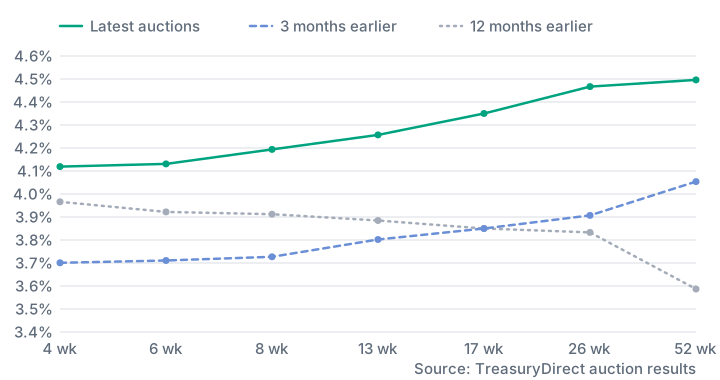
The chart lines up the latest auction of each term and compares it with the auctions three and twelve months earlier.
A year ago the curve sloped down. In mid-November 2025 the 4-week bill paid 3.97% and the 52-week (late October) only 3.59%. Investors were willing to accept less for locking money up for a year, which usually means they expected short-term rates to fall. They did: by December 2025 the 4-week rate had dropped to about 3.65%.
Now it slopes up. The 52-week bill pays about 0.4 points more than the 4-week. The Federal Reserve raised its target range to 3.75%–4.00% in September (the New York Fed’s effective rate moved from 3.63% to 3.88% on Sept. 17), and kept it there at its Oct. 27–28 meeting, when two officials voted for another quarter-point increase. The longer bills have risen more than the short ones. A rising curve like this usually means investors expect short-term rates to stay where they are or go higher over the next year. That is a reading of prices, not a forecast; the curve has been wrong before.
What $10,000 earns in each term
You pay less than face value and get the full $10,000 back at maturity. The difference is your interest.
| Term | Days | You pay | Interest at maturity | After 22% federal tax | Savings APY needed to match* |
|---|---|---|---|---|---|
| 4 week | 28 | $9,968.50 | $31.50 | $24.57 | 4.49% |
| 6 week | 42 | $9,952.69 | $47.31 | $36.90 | 4.50% |
| 8 week | 56 | $9,936.07 | $63.93 | $49.87 | 4.57% |
| 13 week | 91 | $9,894.97 | $105.03 | $81.92 | 4.63% |
| 17 week | 119 | $9,860.18 | $139.82 | $109.06 | 4.72% |
| 26 week | 182 | $9,782.11 | $217.89 | $169.96 | 4.83% |
| 52 week | 364 | $9,566.23 | $433.77 | $338.34 | 4.86% |
*The APY a bank account would need to leave you the same amount after 22% federal and 5% state income tax, over the same number of days. T-bill interest pays no state tax, so the bank needs a higher headline rate to keep up. In a state with no income tax, the break-even is roughly the bill’s investment rate. Try your own brackets in the T-bill calculator.
Which term should you pick?
The rate is only part of the choice. The other part is when you need the money back.
- Money you might need within a couple of months: 4- to 8-week bills. The rates are a little lower, but the money comes back quickly, and you can roll it into a new bill at the next auction. That is how many people use the 4-week bill as a savings account with a state tax break.
- Money with a known date, like a tax bill or a tuition payment: pick the bill that matures just before the date. A 13-week bill bought at the next auction matures Feb. 25; a 17-week bill, March 30.
- Money you won’t touch for a year: the 52-week bill pays the most right now and locks the rate for the whole year. If rates rise further, you miss out; if they fall, you keep 4.5%.
- Not sure: split it. A ladder of bills that mature at different times gives you some money back every few weeks and averages the rates.
- Money you might need any day: a money market fund or a high-yield savings account is simpler, though neither locks a rate. For five years or more, compare the I bond rate.
You can sell a bill before it matures through a brokerage, but the price depends on rates that day, so you could get back a little less than you paid plus interest. Bills held at TreasuryDirect have to be transferred to a broker before you can sell them.
When the next auctions are
| Term | Usual auction day | Next auction | Issue date |
|---|---|---|---|
| 13 and 26 week | Monday | Nov. 23, 2026 (expected) | Nov. 27 (expected) |
| 6 week | Tuesday | Nov. 24, 2026 (expected) | Nov. 27 (expected) |
| 17 week | Wednesday | Nov. 25, 2026 (expected) | Dec. 1 (expected) |
| 4 and 8 week | Thursday | Wednesday, Nov. 25, 2026 (expected; moved for Thanksgiving) | Dec. 1 (expected) |
| 52 week | Every fourth Tuesday | Nov. 24, 2026 (expected) | Nov. 27 (expected) |
Results are published shortly after the auction closes at 11:30 a.m. Eastern. Holidays move the dates, so check TreasuryDirect’s upcoming auctions before you bid.
How to buy
You can buy any of these bills at TreasuryDirect, with a $100 minimum, or through most U.S. brokerages, which usually require $1,000. Either way, choose a non-competitive bid: you accept the rate the auction sets and are guaranteed to get the bills. You pay the same price as the big institutional bidders. Our guide to how to buy T-bills walks through each step, and TreasuryDirect now signs you in with ID.me. To check a bill you already hold, use the CUSIP lookup; every rate on this page is also on our data page.
How we got these numbers: every rate, price and date comes from TreasuryDirect’s published auction results for regular (not cash management) bills. We calculated the dollar examples from the official price per $100 and the break-even APYs with the same compounding formula banks use. The chart is drawn from those results. Rates change every week; check the source before you act. See how we test and our disclaimer.
Questions people ask
What are T-bill rates right now?
At the latest auctions, as of Nov. 19, 2026, the investment rate was 4.119% on the 4-week bill, 4.131% on the 6-week, 4.194% on the 8-week, 4.257% on the 13-week, 4.350% on the 17-week, 4.467% on the 26-week and 4.496% on the 52-week.
Which T-bill term pays the most?
Right now the 52-week bill pays the most, 4.496% at its Oct. 27, 2026 auction. Longer bills pay more today because investors expect short-term rates to stay high or rise. That has not always been true: in October 2025 the 4-week bill paid more than the 52-week.
How often are T-bills auctioned?
Every week except the 52-week bill. The 13- and 26-week bills are auctioned on Mondays, the 6-week on Tuesdays, the 17-week on Wednesdays and the 4- and 8-week on Thursdays. The 52-week bill is auctioned every four weeks on a Tuesday. Holidays shift the schedule.
Are T-bill rates the same as the rate I get?
Yes, if you place a non-competitive bid at TreasuryDirect or through a brokerage. Every winning bidder pays the same price, set by the auction's high rate. If you buy an existing bill on the secondary market instead, your yield depends on the price that day.
Are T-bills better than a high-yield savings account?
It depends on the rates and your taxes. T-bill interest is exempt from state income tax and the rate is locked until maturity; a savings account lets you withdraw any day but the bank can cut the rate. Our T-bill calculator compares the two after tax for your own numbers.
Sources
Update log
- Updated with the Nov. 19 4- and 8-week auctions.
- Updated with the Nov. 18 17-week auction.
- Updated with the Nov. 17 6-week auction.
- Updated with the Nov. 16 13- and 26-week auctions.
- Updated with the Nov. 9 13-, 26- and 6-week and Nov. 12 4-, 8- and 17-week auctions.
- Updated with the Nov. 5 4- and 8-week auctions.
- Updated with the Nov. 2 13- and 26-week, Nov. 3 6-week and Nov. 4 17-week auctions. Added the rates-at-a-glance box at the top.
- Added the Fed's Oct. 28 decision to hold its target range.
- Updated with the Oct. 28 17-week and Oct. 29 4- and 8-week auctions.
- Updated with the Oct. 26 13- and 26-week and Oct. 27 6- and 52-week auctions.
- First published with auctions through Oct. 22, 2026.