52-Week T-Bill Rate: 4.50% at the Oct. 27 Auction
The 52-week T-bill sold at a 4.496% rate on Oct. 27, 2026 (CUSIP 912797WT0, matures Oct. 28, 2027). $10,000 earns $433.77; a bank needs 4.86% APY to match.
52-week T-bill, Oct. 27 auction, CUSIP 912797WT0
Next auction: expected around Tuesday, Nov. 24
- Investment rate
- 4.496%
- Down 0.120 from Sept. 29
- Discount rate
- 4.290%
- $95.662333 per $100
- $10,000 bill
- $9,566.23
- Pays $433.77 on Oct. 28, 2027
- Bank APY to match
- 4.86%
- After 22% federal + 5% state tax
The 52-week Treasury bill sold at a 4.496% investment rate (4.290% discount rate) on Tuesday, Oct. 27, 2026. That is a little below the Sept. 29 auction, at 4.616% the highest in two years, but about 0.9 points more than the same bill paid a year ago. It is the longest Treasury bill, and right now it pays more than any shorter one.
It is auctioned only every four weeks, so this rate is the one to beat until the next auction, expected around Nov. 24. Other terms: T-bill rates today (4 to 52 weeks), the 4-week, 3-month and 6-month pages.
Oct. 27 auction results
| 52-week (1-year) bill | |
|---|---|
| CUSIP | 912797WT0 |
| Auction date | Tuesday, Oct. 27, 2026 |
| High discount rate | 4.290% |
| Investment rate | 4.496% |
| Price per $100 | $95.662333 |
| Issue date | Thursday, Oct. 29, 2026 |
| Maturity date | Thursday, Oct. 28, 2027 (364 days) |
| Offering size | $54 billion |
| Bid-to-cover ratio | 3.15 (normal for this bill) |
Compare the investment rate with a savings account’s or CD’s APY; on a 1-year bill the discount rate runs about 0.2 points lower, the widest gap of any bill. What each line means is in the glossary below.
The last 12 auctions
| Auction | Discount rate | Investment rate | Price per $100 | Bid-to-cover | Offered | CUSIP |
|---|---|---|---|---|---|---|
| Oct 27, 2026 | 4.290% | 4.496% | $95.662333 | 3.15 | $54B | 912797WT0 |
| Sep 29, 2026 | 4.400% | 4.616% | $95.551111 | 3.07 | $54B | 912797WJ2 |
| Sep 1, 2026 | 3.980% | 4.161% | $95.975778 | 3.61 | $52B | 912797WA1 |
| Aug 4, 2026 | 3.880% | 4.054% | $96.076889 | 3.62 | $52B | 912797VR5 |
| Jul 7, 2026 | 3.860% | 4.032% | $96.097111 | 3.14 | $52B | 912797VQ7 |
| Jun 9, 2026 | 3.750% | 3.914% | $96.208333 | 3.34 | $50B | 912797VF1 |
| May 12, 2026 | 3.650% | 3.806% | $96.309444 | 3.41 | $50B | 912797UX3 |
| Apr 14, 2026 | 3.560% | 3.710% | $96.400444 | 3.21 | $50B | 912797UE5 |
| Mar 17, 2026 | 3.485% | 3.630% | $96.476278 | 3.43 | $50B | 912797UD7 |
| Feb 17, 2026 | 3.345% | 3.480% | $96.617833 | 2.96 | $50B | 912797TV9 |
| Jan 20, 2026 | 3.390% | 3.528% | $96.572333 | 3.42 | $50B | 912797TM9 |
| Dec 23, 2025 | 3.380% | 3.517% | $96.591833 | 3.74 | $50B | 912797TC1 |
Twelve auctions cover almost a year, because the bill is sold every four weeks. Holding one and want its details? Look it up in our T-bill CUSIP lookup, which lists every bill sold in the past year.
The past two years
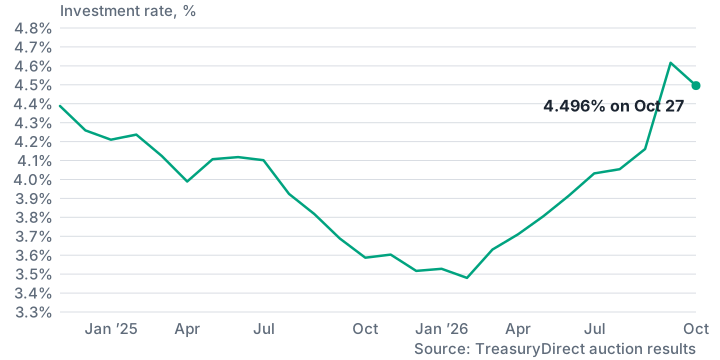
Oct. 29, 2024
4.291%
Two years ago.
Through 2025
4.12% → 3.92% → 3.587%
A slide as short-term rates fell: March, August, then the Oct. 28, 2025 auction.
Feb. 17, 2026
3.480%
The bottom.
March to Sept. 1, 2026
3.630% → 4.161%
Higher at every auction, slowly at first.
Sept. 29, 2026
4.616%
A jump of almost half a point in four weeks. The Fed raised its target range to 3.75%–4.00% in September, and the effective fed funds rate moved from 3.63% to 3.88% on Sept. 17.
Oct. 27, 2026
4.496%
Eased back, still near the two-year high.
Why it moves the most: the 1-year bill locks a rate for the longest time, so it reacts most to what markets expect the Fed to do. A year ago it paid less than the 4-week bill (3.587% against about 4.0%), a sign investors expected rates to fall. Today it pays about half a point more, a sign they expect rates to hold or rise.
What $10,000 earns
T-bills sell at a discount and pay full face value at maturity; the difference is your interest. The Oct. 27 auction applied to $10,000 of face value:
| Amount | |
|---|---|
| You pay on Oct. 29, 2026 | $9,566.23 |
| You get back on Oct. 28, 2027 | $10,000.00 |
| Interest over 364 days | $433.77 |
| After 22% federal tax | $338.34 |
| State and local tax | $0 (exempt) |
The same $9,566.23 in a savings account or CD for 364 days:
| Account and APY | Interest before tax | After 22% federal + 5% state tax |
|---|---|---|
| Savings, 0.38% (FDIC national average, Oct. 2026) | $36.25 | $26.46 |
| 12-month CD, 1.76% (FDIC national average, Oct. 2026) | $167.90 | $122.57 |
| Savings or CD at 4.00% | $381.58 | $278.55 |
| Savings or CD at 4.86% (break-even) | $463.52 | $338.37 |
So a bank account or CD needs about 4.86% APY to match the latest 52-week bill with a 22% federal bracket and 5% state tax, or about 4.55% in a state with no income tax. Try your own brackets in the T-bill calculator.
Tax timing. T-bill interest is taxed in the year the bill matures. A 52-week bill always matures in the next calendar year, so a bill bought in October 2026 puts its interest on your 2027 return. See how T-bills are taxed.
1 year or shorter bills?
| Bill | Latest investment rate | Compared with the 1-year bill |
|---|---|---|
| 4-week | 4.119% (Nov. 19) | 0.38 points less |
| 26-week (6-month) | 4.467% (Nov. 16) | 0.03 points less |
| 52-week (1-year) | 4.496% (Oct. 27) |
The real question is whether locking in for a year beats rolling two 6-month bills. If you bought a 26-week bill now, the one you buy when it matures in mid-May would need to pay about 4.53% to match the 1-year bill, only 0.06 points above today’s 26-week rate. So the edge is thin: the 52-week bill comes out ahead only if the 6-month rate in May is below about 4.53%, and rolling two 6-month bills wins if it is higher. This uses the Oct. 27 52-week rate; the next 52-week auction, expected Nov. 24, will reset it.
The cost of the higher rate is flexibility. You can sell a 52-week bill early through a brokerage, but the price depends on rates that day, and if rates have risen you get back less. Only lock up money you are fairly sure you won’t need for a year. A T-bill ladder gives some money back every few weeks instead, and for money you can leave for five years or more, compare the I bond rate.
| Option | What you earn | Rate locked? | Getting your money | State tax |
|---|---|---|---|---|
| 52-week T-bill | 4.496% investment rate (Oct. 27) | Yes, for 364 days | At maturity, or sell early through a broker | Exempt |
| 26-week T-bill | 4.467% investment rate (Nov. 16) | Yes, for 182 days | At maturity, or sell early | Exempt |
| 12-month CD | 1.76% APY national average; online banks pay far more (T-bills vs. CDs) | Yes, for 12 months | Early withdrawal penalty | Taxed |
| Savings account | 0.38% APY national average | No, the bank can change it any day | Any day | Taxed |
Averages are from the FDIC’s October 2026 table across all U.S. banks; the best online banks pay several times more. For savings accounts and money market funds, see high-yield savings vs. money market and money market fund rates.
When the next auction is
Treasury auctions 52-week bills every four weeks, usually on a Tuesday:
| Step | Date | Detail |
|---|---|---|
| Announcement | Thursday, Nov. 19, 2026 (expected) | Offering size and CUSIP published |
| Auction | Expected around Tuesday, Nov. 24, 2026 | Four weeks after Oct. 27. Non-competitive bids close 11:00 a.m. Eastern, competitive 11:30 a.m. |
| Issue | Friday, Nov. 27, 2026 (expected) | Usually a Thursday; Thanksgiving moves it a day later |
Check TreasuryDirect’s upcoming auctions for the confirmed date. We update this page after every 52-week auction.
How to buy a 52-week T-bill
Either way you place a non-competitive bid: you accept the auction’s rate and are guaranteed the bills. The bills are the same; the accounts differ.
| TreasuryDirect | Brokerage account | |
|---|---|---|
| Minimum | $100, in $100 steps | Usually $1,000, in $1,000 steps |
| Selling before maturity | Hold 45 days, then transfer to a broker to sell | Sell any trading day, at that day’s price |
| Rolling into the next bill | One scheduled reinvestment of a 52-week bill | Automatic rollover at some brokers, such as Fidelity and Schwab |
| Where the cash lands | Your linked bank account | Your brokerage cash balance |
Our guide to how to buy T-bills walks through each step.
Reading the auction numbers
- High discount rate 4.290%
- The rate the auction cleared at, as a markdown from face value on a 360-day year. Every winning bidder, including small non-competitive buyers, pays the same price.
- Investment rate 4.496%
- What you earn on the money you actually pay, on a 365-day year. About 0.2 points above the discount rate on a 1-year bill, the widest gap of any bill, because the discount is the largest.
- Price per $100 $95.662333
- What you pay for each $100 of face value.
- Bid-to-cover ratio 3.15
- Dollars bid for each dollar Treasury sold. This bill has run between about 3 and 3.7 over the past year, so 3.15 is normal demand.
- CUSIP 912797WT0
- The nine-character ID of this specific bill, used by brokers and TreasuryDirect.
Our T-bill calculator converts any discount rate into an investment rate and dollar amounts.
How we got these numbers: auction results come from TreasuryDirect’s published results for each 52-week bill. We calculated the dollar examples from the official price per $100 and the savings examples with the same APY formula banks use. The chart is drawn from the last 26 auctions. Rates change; check the source before you act. See how we test and our disclaimer.
Questions people ask
What is the 52-week T-bill rate right now?
At the Oct. 27, 2026 auction the 52-week bill sold at a 4.290% high discount rate, which works out to a 4.496% investment rate. The investment rate is the one to compare with a savings account APY or a 12-month CD. The next auction is expected around Nov. 24.
Is the 52-week T-bill the same as a 1-year Treasury?
Yes. The 52-week bill is the 1-year Treasury bill, sometimes called the 12-month T-bill. It matures 364 days after it is issued. Treasury also quotes a '1-year constant maturity' yield, which is a market estimate rather than an auction result.
How often is the 52-week T-bill auctioned?
Every four weeks, usually on a Tuesday, with the bills issued that Thursday. Shorter bills are auctioned every week.
How much does a $1,000 52-week T-bill cost?
At the Oct. 27, 2026 price of $95.662333 per $100, a $1,000 bill cost $956.62 and pays $1,000 at maturity on Oct. 28, 2027, so you earn $43.38 over 364 days.
Is a 52-week T-bill better than a 12-month CD?
Often, if you pay state income tax. The national average 12-month CD paid 1.76% APY in October 2026, according to the FDIC, and CD interest is taxed by your state. Some online banks pay much more, so compare the best CD you can get after tax with the bill's investment rate.
Sources
Update log
- Updated the 4-week comparison rate to the Nov. 19, 2026 auction.
- Updated the 26-week comparison to the Nov. 16 auction (4.467%); a second 26-week bill would now need only about 4.53% to match the 1-year bill.
- Updated the 4-week and 26-week comparisons to the Nov. 12 and Nov. 9 auctions and added the expected dates of the next auction.
- Reorganized the page so the rate, price and CUSIP come first; updated the 26-week comparison to the Nov. 2 auction (a second 26-week bill would now need about 4.70%).
- Corrected the rate a second 26-week bill would need to match the 1-year bill: about 4.63%, not 4.53%.
- First published with the Oct. 27, 2026 auction.