I Bond Rate: 5.51% for Nov. 2026 to April 2027
New I bonds pay 5.51% through April 2027, with a 1.40% fixed rate, the highest since 2006. What your old I bonds earn now, and I bonds vs. T-bills.
Series I savings bonds bought from Nov. 1, 2026 through April 30, 2027 earn a 5.51% annual rate for their first six months. Treasury set the rate on Nov. 1. It is made of two parts: a 1.40% fixed rate, which stays with the bond for up to 30 years, and a 2.04% inflation rate for six months, about 4.1% a year.
The fixed rate is the news. At 1.40% it is the highest since November 2006 and half a point above the 0.90% that bonds sold from May to October 2026 got. The fixed rate is a return above inflation that you keep for as long as you hold the bond.
The new rate
| I bonds issued Nov. 2026 to Apr. 2027 | |
|---|---|
| Composite rate | 5.51% |
| Fixed rate (for the life of the bond) | 1.40% |
| Inflation rate (six months) | 2.04% |
| Inflation rate, annualized | 4.08% |
| Previous composite rate (May to Oct. 2026) | 4.26% |
| Previous fixed rate | 0.90% |
| Next rate announcement | May 1, 2027 |
Treasury combines the two parts with this formula:
Composite rate = fixed rate + (2 × semiannual inflation rate) + (fixed rate × semiannual inflation rate)
For the new bonds that is 0.0140 + (2 × 0.0204) + (0.0140 × 0.0204) = 0.0551, or 5.51%. The inflation part comes from the change in the non-seasonally adjusted CPI-U, the consumer price index for all urban consumers, over the six months ending in September.
The rate is quoted as a yearly rate but applies for six months at a time. Interest is added to the bond every month and compounds every six months.
Rate history since 1998
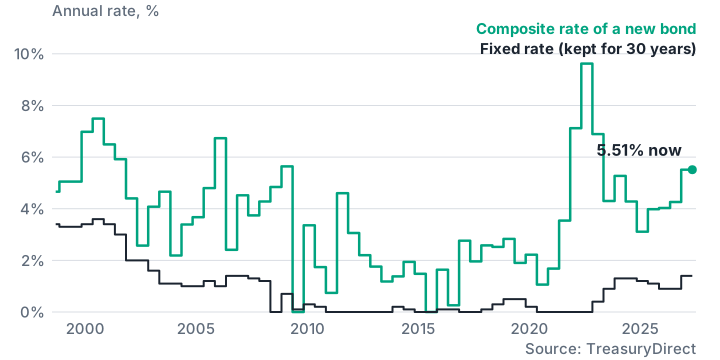
The last five years show how much the two parts move apart:
| Bonds issued from | Fixed rate | Inflation rate (6 months) | Composite rate |
|---|---|---|---|
| Nov. 2026 | 1.40% | 2.04% | 5.51% |
| May 2026 | 0.90% | 1.67% | 4.26% |
| Nov. 2025 | 0.90% | 1.56% | 4.03% |
| May 2025 | 1.10% | 1.43% | 3.98% |
| Nov. 2024 | 1.20% | 0.95% | 3.11% |
| May 2024 | 1.30% | 1.48% | 4.28% |
| Nov. 2023 | 1.30% | 1.97% | 5.27% |
| May 2023 | 0.90% | 1.69% | 4.30% |
| Nov. 2022 | 0.40% | 3.24% | 6.89% |
| May 2022 | 0.00% | 4.81% | 9.62% |
The 9.62% rate of 2022 made I bonds famous, but it came with a 0% fixed rate. Once inflation cooled, those bonds dropped to whatever inflation paid. Today’s bonds start lower but carry 1.40% above inflation for good.
From 2009 to 2022 the fixed rate was 0.5% or less, and often zero. It last stood at 1.40% for bonds bought from May 2006 to April 2007, and it was 3% or more from September 1998 to October 2001. The 5.51% composite rate is the highest a new bond has started at since the 6.89% of November 2022.
What your existing I bonds earn now
The new 2.04% inflation rate applies to every I bond, not only new ones. Each bond adds it to its own fixed rate. Using Treasury’s formula, here is what bonds with each fixed rate earn for their next six months:
| Your bond’s fixed rate | Bought, for example | Next six months |
|---|---|---|
| 0.00% | May 2020 to Oct. 2022 | 4.08% |
| 0.10% | Nov. 2015 to Oct. 2016 | 4.18% |
| 0.20% | Nov. 2019 to Apr. 2020 | 4.28% |
| 0.30% | May 2018 to Oct. 2018 | 4.39% |
| 0.40% | Nov. 2022 to Apr. 2023 | 4.49% |
| 0.50% | Nov. 2018 to Oct. 2019 | 4.59% |
| 0.70% | Nov. 2008 to Apr. 2009 | 4.79% |
| 0.90% | May 2023 to Oct. 2023, Nov. 2025 to Oct. 2026 | 5.00% |
| 1.00% | May 2004 to Apr. 2005 | 5.10% |
| 1.10% | May 2025 to Oct. 2025 | 5.20% |
| 1.20% | Nov. 2024 to Apr. 2025 | 5.30% |
| 1.30% | Nov. 2023 to Oct. 2024 | 5.41% |
| 1.40% | Nov. 2026 to Apr. 2027 | 5.51% |
| 1.60% | Nov. 2002 to Apr. 2003 | 5.71% |
| 2.00% | Nov. 2001 to Oct. 2002 | 6.12% |
| 3.00% | May 2001 to Oct. 2001 | 7.14% |
| 3.30% | Nov. 1998 to Oct. 1999 | 7.45% |
| 3.40% | Nov. 2000 to Apr. 2001 | 7.55% |
| 3.60% | May 2000 to Oct. 2000 | 7.75% |
The oldest bonds do best. I bonds bought from September 1998 to April 2003 carry fixed rates of 1.60% to 3.60% and now earn 5.71% to 7.75%, more than a new bond. Bonds stop earning 30 years after issue, so the first ones, from September 1998, stop in September 2028.
When it starts. The new rate does not start for everyone on Nov. 1. Each bond changes rate every six months from the month it was issued. A bond bought in March changes every March and September, so it gets the new rate starting March 1, 2027. A bond bought in November or May gets it right away. TreasuryDirect’s own table of current composite rates for older bonds may still show the previous period while it is updated; the figures above are our calculation with Treasury’s formula.
Your bond’s fixed rate and every rate it has earned are listed in your TreasuryDirect account, and for paper bonds in Treasury’s I bond rate chart (PDF).
I bonds vs. T-bills and savings
Both I bonds and T-bills are backed by the U.S. Treasury, and the interest on both is free of state and local income tax. The differences are in how long your money is tied up and what you know in advance.
| New I bond | 52-week T-bill | High-yield savings | |
|---|---|---|---|
| Rate today | 5.51% for six months, then 1.40% + inflation | 4.496% for 364 days (Oct. 27 auction) | About 4.2% to 4.3% at the best online banks |
| Rate known for | Six months | The full term | One day; the bank can change it |
| Money locked up | 12 months; three months of interest lost before five years | Until maturity, or sell early at a market price | Never |
| Most you can buy | $10,000 a year per person | $10 million per auction (non-competitive) | No limit; FDIC insured to $250,000 |
| Federal tax | Yes, can be deferred until you cash it | Yes, in the year it matures | Yes, every year |
| State tax | No | No | Yes |
If you need the money in a year, the I bond is likely to lose. Cash it after 12 months and you give up the last three months of interest. If inflation stays where it is, $10,000 in a new I bond would return about $10,416 after 12 months, against about $10,453 for $10,000 put into the Oct. 27 52-week bill. For the I bond to come out ahead over one year, the inflation rate set on May 1, 2027 would have to be about 2.77% for six months, near 5.5% a year.
| $10,000 in a new I bond, cashed after 12 months | You get back |
|---|---|
| Inflation part falls to 0% in May 2027 | about $10,311 |
| Inflation part falls to 1.00% | about $10,363 |
| Inflation part stays at 2.04% | about $10,416 |
| Inflation part rises to 3.00% | about $10,465 |
| For comparison: 52-week T-bill, Oct. 27 auction | about $10,453 |
If you can leave it for five years or more, the I bond’s case is stronger. A T-bill pays whatever rates are when you buy it and again when you roll it over; if the Fed cuts, your income falls. An I bond pays 1.40% above inflation, whatever happens to interest rates. If inflation averaged 4% a year, the bond would pay about 5.4%; if it averaged 2%, about 3.4%. A T-bill does not promise to keep up with inflation at all.
For an emergency fund, neither is ideal on its own. The 12-month lock rules out I bonds for money you might need next month. A high-yield savings account or money market fund is the usual home for that, with 4-week T-bills as a state-tax-free step up.
All figures here are before tax and assume you hold the bond as described. Your bond’s value in TreasuryDirect is calculated by Treasury and may differ by a few dollars from our examples.
Rules worth knowing before you buy
- Where to buy. Electronic I bonds are sold only at TreasuryDirect. Brokerages don’t sell them, though they do sell T-bills; see how to buy T-bills. Paper I bonds bought with a federal tax refund ended on Jan. 1, 2025.
- Who can buy. You need a TreasuryDirect account, which requires a Social Security number, a U.S. address and a U.S. bank account. TreasuryDirect now uses ID.me to sign in; see our TreasuryDirect ID.me login guide.
- How much. From $25, to the penny, up to $10,000 a calendar year per Social Security number. A child, a trust or a business with its own number has its own $10,000 limit, and a bond you give as a gift counts against the recipient’s limit in the year it is delivered.
- When the rate locks. Interest starts on the first day of the month you buy, so any bond issued in April 2027 is treated as issued April 1 and keeps the 1.40% fixed rate. If you are buying near the deadline, leave a few business days before the end of April so the purchase settles that month. Bonds bought from May 1, 2027 get whatever fixed rate Treasury sets that day.
- Cashing in. Not allowed in the first 12 months. Before five years you lose the last three months of interest. The bond stops earning after 30 years.
- Taxes. Interest is subject to federal income tax but not state or local income tax. You can report it every year or wait until you cash the bond. If you use the money for qualified higher education costs, some or all of it may be tax-free; income limits apply.
When the rate changes next
Treasury will announce the next fixed rate and inflation rate on May 1, 2027. The inflation part will reflect the change in the CPI-U from September 2026 to March 2027. Nobody knows the fixed rate in advance; Treasury sets it each time and does not publish a formula for it. We will update this page when the new rates are out.
For other places to park cash, see T-bill rates today for every bill term, and the T-bill calculator to compare a bill with a bank account after tax.
How we got these numbers: the fixed, inflation and composite rates come from TreasuryDirect’s I bond rates page. We calculated the rates for older bonds and the 12-month examples with Treasury’s composite rate formula and its rule that bonds compound every six months and lose three months of interest if cashed before five years. The 52-week bill figure uses the Oct. 27, 2026 auction price. Rates change; check the source before you act. See how we test and our disclaimer.
Questions people ask
What is the I bond rate right now?
5.51% for I bonds issued from Nov. 1, 2026 through April 30, 2027. It combines a 1.40% fixed rate with a 2.04% semiannual inflation rate. The composite rate applies for the bond's first six months; after that the inflation part resets every six months while the fixed rate stays 1.40%.
When does the I bond rate change next?
Treasury announces new rates every May 1 and Nov. 1. The next announcement is May 1, 2027. The inflation part will be based on the change in the CPI-U from September 2026 to March 2027.
How much can I put in I bonds?
Up to $10,000 a calendar year in electronic I bonds per Social Security number, bought at TreasuryDirect. Gifts count toward the recipient's limit, and a child or a business with its own number has its own limit. Paper I bonds bought with a tax refund ended on Jan. 1, 2025.
Can I cash in an I bond early?
Not in the first 12 months. After that you can cash it at any time, but before five years you give up the last three months of interest. After five years there is no penalty.
Are I bonds better than T-bills?
For money you may need within a year or two, usually not: you can't touch an I bond for 12 months and lose three months of interest if you cash it before five years. For money you can leave alone for five years or more, the 1.40% return above inflation is something a T-bill can't lock in.
Sources
Update log
- First published with the rates announced Nov. 1, 2026.