SGOV vs. SPAXX: Which Pays More After Tax? (Nov. 2026)
SGOV yields 3.84% to SPAXX's 3.55%, charges 0.09% against 0.42%, and 95% of its income skips state tax. 29 months of returns, and when SPAXX still wins.
SGOV vs. SPAXX, Nov. 2026
SGOV: iShares, Nov. 6. SPAXX: SEC filing, Oct. 30
- SGOV 30-day SEC yield
- 3.84%
- After its 0.09% expense ratio
- SPAXX 7-day yield
- 3.55%
- After its 0.42% expense ratio
- SGOV income free of state tax
- 95.14%
- 2025; passes the CA, CT, NY test
- SPAXX income free of state tax
- 50.90%
- 2025; failed the CA, CT, NY test
SGOV pays more than SPAXX, and it keeps more of it after state tax. On Nov. 6, 2026, the iShares 0-3 Month Treasury Bond ETF (SGOV) had a 30-day SEC yield of 3.84%. Fidelity Government Money Market Fund (SPAXX), the fund Fidelity sweeps idle cash into, had a 7-day yield of 3.55% on Oct. 30, the latest day in its monthly SEC filing. On $50,000 that difference is about $145 a year before any state tax.
Both funds own much the same kind of thing: very short-term U.S. government debt. The gap comes from what they charge and from what they hold besides Treasury bills, which decides how much of the income your state can tax. What SPAXX offers in return is convenience, and for some cash that is worth more than the extra yield.
SGOV vs. SPAXX at a glance
| SGOV | SPAXX | |
|---|---|---|
| What it is | Exchange-traded fund (ETF) | Government money market fund |
| Yield | 3.84% 30-day SEC yield, Nov. 6, 2026 | 3.55% 7-day yield, Oct. 30, 2026 |
| Expense ratio | 0.09% | 0.42% |
| What it holds | U.S. Treasury bills maturing within about 3 months | Treasury securities, agency debt, repurchase agreements |
| Income from U.S. government obligations, 2025 | 95.14% | 50.90% |
| Met the California, Connecticut, New York test, 2025 | Yes | No |
| Share price | Market price, about $100.50 | $1.00 (aims to keep it there) |
| How you buy it | Trade it like a stock; $0 online commission at Fidelity | Automatic as Fidelity’s core position |
| Cash from a sale | Next business day (T+1) | Available right away |
| Dividends | Monthly | Monthly |
| Size | $116 billion (Nov. 9) | $458 billion, all classes (Oct. 31) |
| Calendar-year return | 5.28% in 2024, 4.24% in 2025 | 4.92% in 2024, 3.95% in 2025 |
SGOV’s yields, fee, size, price and returns come from iShares’ SGOV page and its summary prospectus. SPAXX’s yield, holdings and size come from its Form N-MFP3 for October, filed with the SEC on Nov. 6, and its fee and returns from its summary prospectus. The tax shares are from each company’s 2025 report, linked below. Fidelity’s fund pages don’t load for automated readers, so we use the SEC filing, which lists SPAXX’s 7-day yield for every business day of the month.
The two yields aren’t measured quite the same way. SGOV’s 30-day SEC yield is the income it earned over the past 30 days after expenses, stated as a yearly rate; SPAXX’s 7-day yield does the same over seven days. They also come from dates a week apart. That is why the returns below matter more than any one day’s yields.
29 months of returns: SGOV ahead by about 0.3 points a year
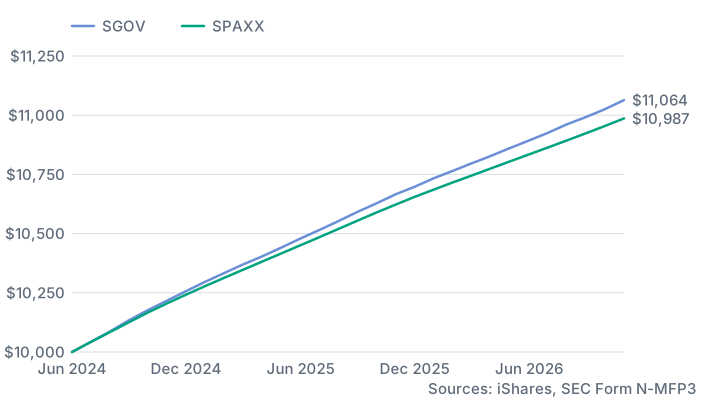
Comparing returns avoids the yield-definition problem. Here is $10,000 left in each since the end of May 2024, with dividends reinvested:
| Period | SGOV | SPAXX | Gap |
|---|---|---|---|
| 12 months to Oct. 31, 2026 | 3.73% | about 3.43% | 0.30 |
| 2025 | 4.24% | 3.95% | 0.29 |
| 2024 | 5.28% | 4.92% | 0.36 |
| June 2024 to Oct. 2026, total | 10.64% | about 9.87% | 0.77 |
SGOV’s figures are its monthly NAV total returns from iShares. Fidelity reports SPAXX’s calendar-year returns but not its monthly ones, so for the other rows we estimated SPAXX’s return from the daily 7-day yields in its SEC filings: each day earns that day’s yield divided by 365. For 2025 that method gives 3.96%, against the 3.95% Fidelity reports, so the estimates are close.
Month by month, SGOV was ahead in 27 of the 29 months; SPAXX edged it in March 2025 and November 2025. The past 12:
| Month | SGOV | SPAXX (est.) | SGOV, yearly rate | SPAXX, yearly rate |
|---|---|---|---|---|
| Oct. 2026 | 0.352% | 0.298% | 4.14% | 3.51% |
| Sept. 2026 | 0.297% | 0.278% | 3.61% | 3.38% |
| Aug. 2026 | 0.286% | 0.282% | 3.37% | 3.32% |
| July 2026 | 0.335% | 0.280% | 3.94% | 3.30% |
| June 2026 | 0.295% | 0.270% | 3.59% | 3.29% |
| May 2026 | 0.302% | 0.277% | 3.55% | 3.26% |
| Apr. 2026 | 0.298% | 0.270% | 3.62% | 3.29% |
| Mar. 2026 | 0.296% | 0.281% | 3.49% | 3.30% |
| Feb. 2026 | 0.275% | 0.255% | 3.59% | 3.32% |
| Jan. 2026 | 0.296% | 0.286% | 3.49% | 3.37% |
| Dec. 2025 | 0.340% | 0.297% | 4.00% | 3.49% |
| Nov. 2025 | 0.295% | 0.299% | 3.59% | 3.63% |
SGOV’s monthly numbers bounce more than SPAXX’s, from 3.37% to 4.14% as a yearly rate over the past year. That is because SGOV is valued at market prices every day, so a small move in Treasury bill prices at a month end shows up in that month’s return and evens out in the next. SPAXX keeps a $1.00 price, so its return tracks its yield almost exactly. Over a full year the bumps cancel out, and what is left is roughly the difference in fees: 0.42% minus 0.09% is 0.33 points.
Why SGOV costs less
SGOV is an index fund. It tracks the ICE 0-3 Month US Treasury Securities Index, and under its prospectus it must keep at least 90% of its assets in U.S. Treasury securities. Its 0.09% management fee covers almost everything; under the prospectus, BlackRock pays the fund’s ordinary operating costs.
SPAXX is a managed money market fund that charges 0.42%. Before fees it earns about the same as other government money funds: at the end of October its 7-day yield before fees was 3.97%. The 0.42 points it keeps is the whole story of why it trails.
What each one owns
On Nov. 9, 2026, SGOV held 23 different Treasury bills maturing between Nov. 10, 2026 and Feb. 11, 2027, plus 0.56% in a BlackRock Treasury money market fund. The bills add up to 108.7% of net assets, offset by a negative cash line of 9.3%, which usually reflects purchases not yet settled. On Nov. 6, the weighted average maturity was 0.11 years, about 40 days, and the average yield to maturity before fees was 3.97%.
SPAXX’s holdings on Oct. 31, from its SEC filing:
| Holding | Share |
|---|---|
| U.S. Treasury securities | 44.3% |
| Repurchase agreements | 28.4% |
| Government agency debt (Federal Home Loan Banks, Farm Credit) | 27.2% |
The repurchase agreements are short loans backed by Treasury and agency collateral. They are low-risk, but their income doesn’t count as interest from U.S. government obligations for state tax, which is where the next difference comes from.
The state tax difference
Federal tax treats both funds’ dividends as ordinary income. Most states let you leave out the part of a fund’s dividends that came from U.S. government obligations. Each January, fund companies publish that share for the year before:
| Share of 2025 income from U.S. government obligations | Share | Met the CA, CT, NY test |
|---|---|---|
| SGOV | 95.14% | Yes |
| SPAXX | 50.90% | No |
| FDLXX (Fidelity Treasury Only) | 98.67% | Yes |
Sources: iShares and Fidelity 2025 reports.
California, Connecticut and New York only allow the exclusion if at least half of a fund’s assets were in U.S. government obligations at the end of every quarter. Fidelity says SPAXX did not meet that test for 2025, so in those three states none of its 2025 income was exempt. Its SEC filings show why: at the ends of March and June 2025, Treasury, Federal Home Loan Bank and Farm Credit debt made up only about 45% and 40% of the fund, with repurchase agreements filling the rest. In 2026 that share has been above half at every month end, from about 58% to 72%, so SPAXX may pass for 2026; Fidelity’s January report will settle it. iShares says SGOV had at least half its assets in federal obligations at the end of each quarter, so it met the test.
Here is what each yield is worth after state tax at the current yields (SGOV 3.84%, SPAXX 3.55%), using the 2025 shares:
| Where you live | SGOV after state tax | SPAXX after state tax | SGOV’s extra on $50,000 a year |
|---|---|---|---|
| No state income tax, or an IRA | 3.84% | 3.55% | about $145 |
| A state with a 5% rate that exempts government income | 3.83% | 3.46% | about $185 |
| California, 9.3% bracket, if SPAXX fails the test again | 3.82% | 3.22% | about $300 |
| California, 9.3% bracket, if SPAXX passes | 3.82% | 3.39% | about $215 |
The math for the 5% row: SPAXX’s taxable share is 49.10%, so the state takes 3.55% × 0.491 × 0.05, about 0.09 points. SGOV’s taxable share is 4.86%, so it loses less than 0.01 point. In the first California row, all of SPAXX’s yield is taxed at 9.3%, as it was for 2025; in the second, only its 49.10% non-government share is, which is what would happen if SPAXX meets the test for 2026. The table leaves out the federal deduction for state taxes, which trims the difference a little for people who itemize, and the shares change every year. Rules differ by state, so check yours; how T-bills are taxed covers the basics.
What you give up with SGOV
SGOV’s extra yield comes with a few practical costs.
- It isn’t automatic. At Fidelity, cash from deposits, sales and dividends lands in the core position, typically SPAXX. SGOV can’t be the core position. You buy it with a trade, and when you need the money you sell it and wait for the trade to settle.
- Cash takes a business day. Stock and ETF trades settle one business day after the trade under the SEC’s T+1 rule, in effect since May 28, 2024. Selling SGOV on a Friday settles on Monday. Fidelity lets you use the proceeds to buy other securities before then, but you can’t withdraw or transfer them out until the sale settles. Cash in SPAXX is available right away.
- The price moves. SGOV’s net asset value creeps up every day as its bills earn interest, then drops by about the amount of each monthly dividend. It was $100.74 on Oct. 30, 2026 and $100.42 on Nov. 2, the day a $0.328581 dividend went ex. Over the past year it ranged from $100.27 to $100.74. Since the start of 2023 it has fallen on a day without a dividend only six times, by 1.1 cents at most. So your balance can be a few cents per share lower than you paid for a day or two, but because the price carries the interest built up so far, you don’t lose interest by buying or selling mid-month.
- You trade at the market price. You buy at the ask and sell at the bid, not at the fund’s exact value. SGOV’s median bid-ask spread over the 30 days to Nov. 9 was 0.01%, about $5 on $50,000, and its price closed at its net asset value that day. Fidelity charges $0 commission on online ETF trades.
None of this makes SGOV risky in the usual sense. Its holdings are Treasury bills, the same bills you could buy at auction yourself. It isn’t FDIC insured, but neither is SPAXX; shares of both held in a brokerage account are covered by SIPC, which protects against missing assets if the brokerage fails, not against a fall in value.
SGOV vs. buying T-bills directly
If you’re willing to trade SGOV, you can also buy the bills it owns. A 4-week T-bill sold at a 4.119% investment rate on Nov. 19, 2026, and a 13-week bill at 4.257% on Nov. 16. Bills charge no fee and their interest is 100% free of state tax, so they pay a little more than SGOV’s 3.84%.
The trade-off is that a bill locks your money until it matures, or you sell it at the market price, and you have to roll it over yourself. SGOV does the rolling for you and lets you sell any day. For a set amount you won’t touch for a few months, bills or a T-bill ladder pay more; for a balance that goes up and down, SGOV is simpler. Compare all terms on our T-bill rates page, or look up any bill on the CUSIP lookup.
Which should you use?
- Cash you’ll spend or invest within days: leave it in SPAXX. The extra yield on a week’s worth of cash is pennies, and SPAXX settles instantly.
- A balance that stays put in a taxable account: SGOV paid about 0.3 points more before tax and kept more after state tax, most of all in California, Connecticut and New York. Keep a small amount in SPAXX for bills and trades, and the rest in SGOV.
- In an IRA or a state with no income tax: SGOV still came out about 0.3 points ahead over the past year. Whether that is worth a trade each time you add or take out money is up to you.
- You want a $1.00 price and good state tax treatment at Fidelity: Fidelity Treasury Only Money Market Fund (FDLXX) paid 3.61% on Oct. 30 and 98.67% of its 2025 income was state-exempt. It is the Fidelity money fund closest to SGOV on taxes, though its 0.42% fee keeps its yield below SGOV’s.
- $100,000 or more and you’d rather stay in SPAXX’s fund: Fidelity’s Premium Class (FZCXX) holds the same portfolio for 0.32% and paid 3.65% on Oct. 30. See our SPAXX page for details, and the money market fund comparison for Vanguard and Schwab options.
How we got these numbers: SGOV’s 30-day SEC yield, net assets, prices, spread and portfolio come from iShares’ fund page and its downloadable fund data, recorded on Nov. 10, 2026; its monthly and calendar-year returns, daily net asset values and distributions from the same download; its fee from the summary prospectus dated June 29, 2026. SPAXX’s daily 7-day yields, holdings and size come from Fidelity Government Money Market Fund’s monthly Form N-MFP3 filings with the SEC from June 2024 through Oct. 31, 2026; its calendar-year returns and fee from its summary prospectus. SPAXX’s monthly returns are our estimate from those daily yields, as explained above. State tax shares come from iShares’ and Fidelity’s 2025 reports. T-bill rates are from TreasuryDirect. We update this page each month when Fidelity’s new SEC filing arrives. We are not paid by BlackRock, iShares or Fidelity. See how we test and our disclaimer.
Questions people ask
Is SGOV better than SPAXX?
For cash that sits for a while in a taxable account, usually yes. SGOV's 30-day SEC yield was 3.84% on Nov. 6, 2026 against SPAXX's 3.55% 7-day yield on Oct. 30, mainly because SGOV charges 0.09% a year and SPAXX 0.42%. SGOV's income is also almost entirely free of state tax. SPAXX is simpler for cash you'll spend or invest soon, because it is Fidelity's core position and keeps a $1.00 price.
Is SGOV safe?
It holds U.S. Treasury bills that mature within about three months, backed by the U.S. government, plus a small slice of a Treasury money market fund. Its price still moves a little: SGOV's net asset value ranged from $100.27 to $100.74 over the past year, mostly rising as interest built up and dropping each time a monthly dividend went ex. It is not FDIC insured, and neither is SPAXX.
Can SGOV be my core position at Fidelity?
No. Fidelity's core position, where cash settles automatically, is a money market fund such as SPAXX or a bank sweep, depending on the account. You can buy SGOV with $0 commission in an online trade, but you have to buy and sell it yourself, and the cash from a sale arrives in the core position one business day later.
Is SGOV income taxed by my state?
Mostly not. iShares reported that 95.14% of SGOV's 2025 income came from U.S. government obligations, which most states exempt, and that the fund met the 50% test California, Connecticut and New York require. For SPAXX, Fidelity reported 50.90% and said the fund did not meet that test, so in those three states all of SPAXX's 2025 income was taxable. SPAXX's SEC filings show it above half in government debt at every month end of 2026 so far, so it may pass for 2026; Fidelity's report in January will say. Federal tax applies to all of both.
How often does SGOV pay dividends?
Monthly. The ex-dividend date is usually the first business day of the month, and the payment comes a few days later; on Nov. 2, 2026 it was $0.328581 a share. In December 2025 there was a second, year-end distribution. SPAXX also pays monthly. With either, you earn interest for every day you hold it, because SGOV's price includes the interest built up since the last dividend.
What about Fidelity's Treasury Only Money Market Fund instead?
FDLXX is the Fidelity fund closest to SGOV on taxes: 98.67% of its 2025 income came from U.S. government obligations, and it met the California, Connecticut and New York test. It still charges 0.42% a year, so its 7-day yield was 3.61% on Oct. 30, below SGOV's 3.84% SEC yield. It keeps a $1.00 price, but like SGOV it is not the core position.
Sources
- iShares 0-3 Month Treasury Bond ETF (SGOV) fund page: yields, fees, net assets and distributions as of Nov. 6 to 9, 2026
- iShares 0-3 Month Treasury Bond ETF summary prospectus, June 29, 2026
- iShares: 2025 U.S. government source income information
- SEC Form N-MFP3, Fidelity Government Money Market Fund (SPAXX), Oct. 31, 2026
- SEC EDGAR: all N-MFP3 filings by Fidelity Hereford Street Trust (SPAXX's trust)
- SEC Form N-MFP3, Fidelity Treasury Only Money Market Fund (FDLXX), Oct. 31, 2026
- Fidelity Government Money Market Fund summary prospectuses (SPAXX and Premium Class FZCXX), June 29, 2026
- Fidelity: 2025 percentage of income from U.S. government securities
- Fidelity: Commissions and fees (online ETF trades)
- Fidelity: Cash Management Account FAQs (core position options)
- SEC: rules shortening the standard settlement cycle to T+1 from May 28, 2024
- TreasuryDirect: auction results for 4- and 13-week bills
Update log
- Updated the 4-week T-bill comparison to the Nov. 19, 2026 auction.
- Updated the 13-week T-bill comparison to the Nov. 16, 2026 auction.
- Updated the 4-week T-bill comparison to the Nov. 12, 2026 auction.