SPAXX 7-Day Yield: 3.55%, and Why It Trails VMFXX
Fidelity's SPAXX paid a 3.55% 7-day yield in its latest SEC filing. Its 0.42% fee, 29 months of history vs. VMFXX, state tax and when to move your cash.
SPAXX paid a 3.55% 7-day yield on Oct. 30, 2026, the last business day in the latest monthly report Fidelity files with the SEC. That is up from 3.48% at the end of September and 3.33% at the end of August, after the Federal Reserve raised rates in September. On $10,000 it works out to about $355 a year, before tax, if the yield held steady.
SPAXX, the Fidelity Government Money Market Fund, is where cash lands in many Fidelity accounts, which makes it one of the largest money market funds in the country: $458 billion across all share classes. It is low-risk and easy. It is also more expensive than its closest rivals, and that, not what it owns, is why it pays less.
SPAXX at a glance
| SPAXX | |
|---|---|
| 7-day yield, Oct. 30, 2026 | 3.55% |
| 7-day yield before fees | 3.97% |
| Expense ratio | 0.42% (0.25% management fee, 0.17% other) |
| Minimum | None |
| Share price | $1.00 (aims to keep it there) |
| Fund type | Government money market fund |
| Fund size | $458 billion; $428 billion in the SPAXX share class |
| Weighted average maturity | 39 days |
| Calendar-year return | 4.92% in 2024, 3.95% in 2025 |
Yield and holdings come from the Oct. 31 Form N-MFP3; fees, minimum and returns from the fund’s June 29, 2026 summary prospectus. Fidelity shows the daily yield on its own fund page, which we can’t record reliably, so we use the SEC filing, which lists the 7-day yield for every business day of the month. The November filing is due in early December, and we will update this page with it.
SPAXX vs. VMFXX: the same yield before fees
The 7-day yield is the fund’s income over the past week after expenses, stated as a yearly rate. The N-MFP3 also reports the yield before expenses. Put SPAXX next to Vanguard Federal Money Market Fund (VMFXX), the default cash fund at Vanguard, and the two are almost tied before fees:
| Oct. 30, 2026 | SPAXX | VMFXX |
|---|---|---|
| 7-day yield before fees | 3.97% | 3.99% |
| Expense ratio | 0.42% | 0.11% |
| 7-day yield | 3.55% | 3.88% |
| Minimum | None | $3,000 |
| Weighted average maturity | 39 days | 25 days |
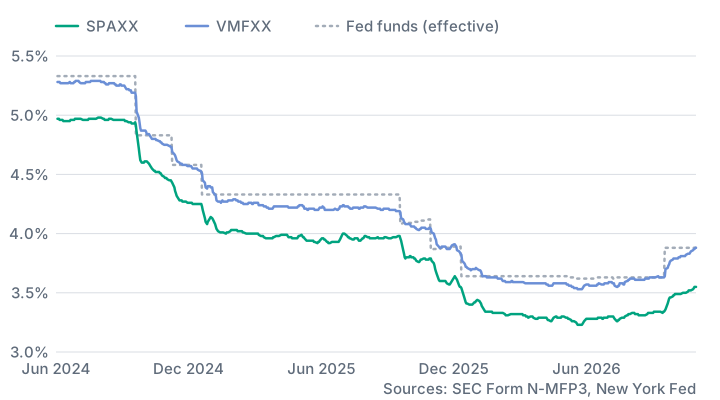
Nearly all of the difference is the fee. And it isn’t a one-month accident. Every monthly filing since the SEC introduced Form N-MFP3 in June 2024 shows the same pattern:
| Month end | SPAXX 7-day yield | Before fees | VMFXX 7-day yield | Gap |
|---|---|---|---|---|
| Oct. 2026 | 3.55% | 3.97% | 3.88% | 0.33 |
| Sept. 2026 | 3.48% | 3.90% | 3.79% | 0.31 |
| Aug. 2026 | 3.33% | 3.75% | 3.63% | 0.30 |
| July 2026 | 3.32% | 3.74% | 3.62% | 0.30 |
| June 2026 | 3.29% | 3.71% | 3.58% | 0.29 |
| May 2026 | 3.26% | 3.67% | 3.56% | 0.30 |
| Apr. 2026 | 3.30% | 3.72% | 3.58% | 0.28 |
| Mar. 2026 | 3.29% | 3.71% | 3.58% | 0.29 |
| Feb. 2026 | 3.32% | 3.74% | 3.59% | 0.27 |
| Jan. 2026 | 3.33% | 3.75% | 3.62% | 0.29 |
| Dec. 2025 | 3.43% | 3.85% | 3.71% | 0.28 |
| Nov. 2025 | 3.60% | 4.02% | 3.90% | 0.30 |
| Oct. 2025 | 3.77% | 4.19% | 4.01% | 0.24 |
| Sept. 2025 | 3.80% | 4.22% | 4.08% | 0.28 |
The gap is in percentage points. Over all 29 month ends from June 2024 to October 2026, it ranged from 0.24 to 0.33 points and averaged 0.28. The “before fees” column is 0.41 to 0.43 points above SPAXX’s yield every month, about its 0.42% expense ratio: Fidelity takes its fee out of the income every day, in good months and bad.
What 0.3 points means in dollars, at today’s yields:
| Cash balance | Extra a year at VMFXX’s yield |
|---|---|
| $10,000 | about $30 |
| $50,000 | about $150 |
| $250,000 | about $750 |
Why SPAXX moves with the Fed, a few weeks late
SPAXX’s yield follows the federal funds rate down and up, with a lag. When the Fed raised its target range to 3.75%–4.00% in September 2026, the effective rate rose from 3.63% to 3.88% on Sept. 17. SPAXX was at 3.34% on Sept. 16, 3.45% on Sept. 23 and 3.48% on Sept. 30, and it kept rising in October as older bills matured and were replaced at the new rate: 3.50% on Oct. 15 and 3.55% on Oct. 30. Six weeks after the hike, it had still added only about 0.2 points of the Fed’s 0.25. The same lag works on the way down: after the Fed’s December 2025 cut, SPAXX went from 3.55% on Dec. 10 to 3.42% a week later and 3.34% by mid-January.
Two things cause the delay. The 7-day yield looks back a week, and the fund holds bills and notes bought before the change, which keep paying the old rate until they mature. With a weighted average maturity of 39 days, most of the portfolio matures or resets its rate within about two months.
What SPAXX owns
On Oct. 31, 2026, by market value of its holdings:
| Holding | Share |
|---|---|
| U.S. Treasury bills and notes | 44.4% |
| Repurchase agreements backed by Treasury or agency securities | 28.4% |
| Federal Home Loan Bank debt | 18.8% |
| Federal Farm Credit Banks debt | 8.0% |
| Fannie Mae and Freddie Mac debt | 0.4% |
A forward-settling repurchase agreement made up the last 0.03%.
The prospectus requires the fund to keep at least 99.5% of its assets in cash, U.S. government securities and fully collateralized repurchase agreements; that is what makes it a government money market fund. At the end of October, 59% of its assets could be turned into cash within a day and 71% within a week, far above the SEC’s minimums of 25% and 50%. Its market-based value per share, which the fund reports daily, stayed between $0.9997 and $0.9999 during October, so the $1.00 price had plenty of room.
None of this makes SPAXX a bank account. The prospectus says plainly that you could lose money, that the fund is not FDIC insured and that Fidelity is not required to reimburse losses. In practice, large government money market funds have kept their $1.00 price through past crises, including 2008 and March 2020.
How SPAXX is taxed
SPAXX’s dividends are ordinary income for federal tax. For state income tax, most states exempt the part that came from U.S. government obligations. That includes Treasury debt and, in most states, Federal Home Loan Bank and Farm Credit debt, but not repurchase agreements or Fannie Mae and Freddie Mac debt.
On Oct. 31, those exempt kinds made up about 71% of SPAXX’s holdings, up from 67% a month earlier. The share moves month to month, so use the figure Fidelity publishes with its tax information each January, not a single month’s mix. For 2025, Fidelity reported that 50.90% of SPAXX’s dividends came from U.S. government obligations. California, Connecticut and New York allow the exemption only if at least half of the fund’s assets were in U.S. government obligations at the end of each quarter of the fund’s tax year, and Fidelity says SPAXX did not meet that test for 2025, so in those three states all of its 2025 income was taxable. Its filings show why: at the ends of March and June 2025, Treasury, Federal Home Loan Bank and Farm Credit debt made up only about 45% and 40% of the fund. In 2026 that share has been above half at every month end so far, so SPAXX may pass for 2026; Fidelity’s January report will settle it.
If state tax matters to you, a Treasury-only fund or T-bills go further. Fidelity’s Treasury Only Money Market Fund (FDLXX) paid a 3.61% 7-day yield at the end of October, more than SPAXX’s 3.55%, while holding nothing but Treasury securities; 98.67% of its 2025 income was state-exempt, and it met the three-state test. The ETF SGOV goes further on cost; see SGOV vs. SPAXX. And T-bill interest is exempt from state tax in every state. See our money market fund comparison for how the funds’ holdings differ.
Should you keep your cash in SPAXX?
When you open some Fidelity accounts, SPAXX is one of the choices for the core position, the place cash settles automatically after a deposit, a sale or a dividend. For the Cash Management Account, Fidelity lists two: SPAXX and its FDIC-Insured Deposit Sweep. So many people own SPAXX without having picked it. Whether to leave it there depends on how much cash it is and how long it sits:
- Cash you’re about to spend or invest: leaving it in SPAXX is fine. It pays every day, has no minimum and settles instantly within Fidelity.
- $100,000 or more that stays put: look at the Premium Class of the same fund (FZCXX). It owns the identical portfolio for 0.32% a year, a cap Fidelity has agreed to through Aug. 31, 2027, and paid 3.65% on Oct. 30, 0.10 points more than SPAXX. The minimum is $100,000, or $10,000 in a Fidelity IRA.
- A large balance you won’t need for a month or more: a 4-week T-bill sold at a 4.119% investment rate on Nov. 19, 2026, and its interest is free of state tax. You can buy bills at auction in a Fidelity account, usually with no commission online; see how to buy T-bills at Fidelity. For several months or more, compare T-bill rates by term or set up a T-bill ladder.
- A balance that stays put in a taxable account: the Treasury bill ETF SGOV charges 0.09% a year and paid a 3.84% 30-day SEC yield on Nov. 6, with almost all of its income free of state tax. You buy and sell it yourself, and its price moves a few cents. Our SGOV vs. SPAXX comparison has the returns and the after-tax math.
- You’d rather have bank deposits: see high-yield savings vs. money market. The best online savings accounts were paying more than SPAXX in late October, with FDIC insurance, but their rates can drop at any time.
- You’re thinking of moving to Vanguard for VMFXX: the 0.3 point gap is real but small on modest balances: about $30 a year on $10,000. Moving an account is worth it only if the balance is large or you prefer Vanguard for other reasons. See our VMFXX yield page for its record and how it compares with Vanguard’s Treasury fund.
How we got these numbers: SPAXX’s yields, holdings, assets, liquidity and daily share values come from Fidelity Government Money Market Fund’s monthly Form N-MFP3 filings with the SEC, from June 2024 through Oct. 31, 2026, read with a script that collects the SPAXX share class’s 7-day net yield and the fund’s 7-day gross yield for every business day; VMFXX figures come from Vanguard’s filings the same way. Fidelity’s October 2026 filings date each day’s yield one day early (they list Sept. 30 and Sundays but no Fridays), so we moved those dates forward a day; the last entry is Oct. 30. Fees, the minimum, Premium Class terms and calendar-year returns come from the fund’s summary prospectuses dated June 29, 2026. The fed funds rate is from the Federal Reserve Bank of New York. We update this page each month when the new filing arrives. We are not paid by Fidelity or Vanguard. See how we test and our disclaimer.
Questions people ask
What is the SPAXX 7-day yield?
3.55% on Oct. 30, 2026, the last business day in Fidelity's latest monthly Form N-MFP3 filing with the SEC. It was 3.33% at the end of August and 3.48% at the end of September, rising after the Federal Reserve raised rates in mid-September. The yield changes every business day; Fidelity's fund page shows the current figure.
Is SPAXX a good place to keep cash?
It is a low-risk and convenient one. SPAXX holds Treasury bills, government agency debt and repurchase agreements backed by them, keeps a $1.00 share price and has no minimum. Its weak point is cost: at 0.42% a year, it pays about 0.3 points less than Vanguard's VMFXX, which owns much the same things.
Is SPAXX FDIC insured?
No. SPAXX is a mutual fund, not a bank deposit. Its prospectus says you could lose money and that Fidelity is not required to cover losses. Shares held in a Fidelity brokerage account are covered by SIPC if the brokerage fails, which protects against missing assets, not against a fall in the fund's value.
Why is SPAXX lower than VMFXX?
Fees. At the end of October, SPAXX earned 3.97% and VMFXX 3.99% before expenses. SPAXX's expense ratio is 0.42% and VMFXX's is 0.11%, so SPAXX paid 3.55% and VMFXX 3.88%. A gap of 0.24 to 0.33 points shows up at every month end since June 2024.
Is SPAXX income taxed by my state?
Partly. Income from Treasury securities and some agency debt, such as Federal Home Loan Bank notes, is exempt in most states; income from repurchase agreements is not. Fidelity reported that 50.90% of SPAXX's 2025 dividends came from U.S. government obligations, and that the fund did not meet the test California, Connecticut and New York require, so in those states none of its 2025 income was exempt. Federal tax applies to all of it.
How do I switch out of SPAXX?
You can sell SPAXX like any fund and buy another money market fund, a T-bill or SGOV in the same account. Changing the core position itself, the place cash settles automatically, is a setting in your Fidelity account; the choices depend on the account type.
Sources
- SEC Form N-MFP3, Fidelity Government Money Market Fund, Oct. 31, 2026
- SEC Form N-MFP3, Fidelity Government Money Market Fund, Sept. 30, 2026
- SEC Form N-MFP3, Vanguard Federal Money Market Fund, Oct. 31, 2026
- SEC Form N-MFP3, Fidelity Treasury Only Money Market Fund, Oct. 31, 2026
- SEC EDGAR: all N-MFP3 filings by Fidelity Hereford Street Trust (SPAXX's trust)
- Fidelity Government Money Market Fund summary prospectuses (SPAXX and Premium Class FZCXX), June 29, 2026
- Vanguard Federal Money Market Fund (VMFXX) fund page
- Fidelity: 2025 percentage of income from U.S. government securities
- Fidelity: Cash Management Account FAQs (core position options)
- Federal Reserve Bank of New York: effective federal funds rate
- TreasuryDirect: auction results for 4-week bills
Update log
- Updated the 4-week T-bill comparison to the Nov. 19, 2026 auction.
- Updated the 4-week T-bill comparison to the Nov. 12, 2026 auction.
- Added Fidelity's 2025 state tax figures: 50.90% of SPAXX's income came from U.S. government obligations, and the fund did not meet the California, Connecticut and New York test. We had said SPAXX was well above that test's threshold on Sept. 30, which did not settle the question. Added a comparison with SGOV.
- Updated with the Oct. 31, 2026 SEC filings: SPAXX 3.55%, VMFXX 3.88%, holdings and liquidity.
- Updated the 4-week T-bill comparison to the Nov. 5, 2026 auction.
- First published with SEC filings through Sept. 30, 2026.